You have 120 products in the store, and you haven't written a single description yet. Suppliers sent you descriptions that were barely translated, or worse: the same description 15 other merchants use. And you thought: "I'll just give it to ChatGPT". That can work, as long as you do it right. Do it wrong, and you will publish 120 descriptions that look alike and contain information that isn't true.
This article explains writing product descriptions with AI: when it works, how to write a prompt that produces a true description, what Google thinks of generated content, and how to avoid duplicate descriptions and accuracy problems.
In short: writing product descriptions with AI is possible and saves time if you start with real information about the product (material, sizes, use) and review every description yourself. Google doesn't ban generated content, but it treats generating many pages with no value as a violation of its spam policy. And keep every description different from the others and written for a real customer.
Can I write product descriptions with AI?
The description that sells is the one that answers the customer's questions: what is the material? Is the size right? How will I use it? Can I return it? AI helps you phrase those answers quickly, but it doesn't know your product. It predicts likely words. So if you leave it without data, it will invent specifications (for example "100% cotton" when you don't know that).
Use it for: phrasing the text, organizing ideas, generating different versions, and writing the title and meta. And keep yourself as the source of truth: the material, sizes, price and guarantee.
If you want the basics of a description that sells, with ready prompts, first read using ChatGPT and Claude for your store.
What is Google's position on AI-written content?
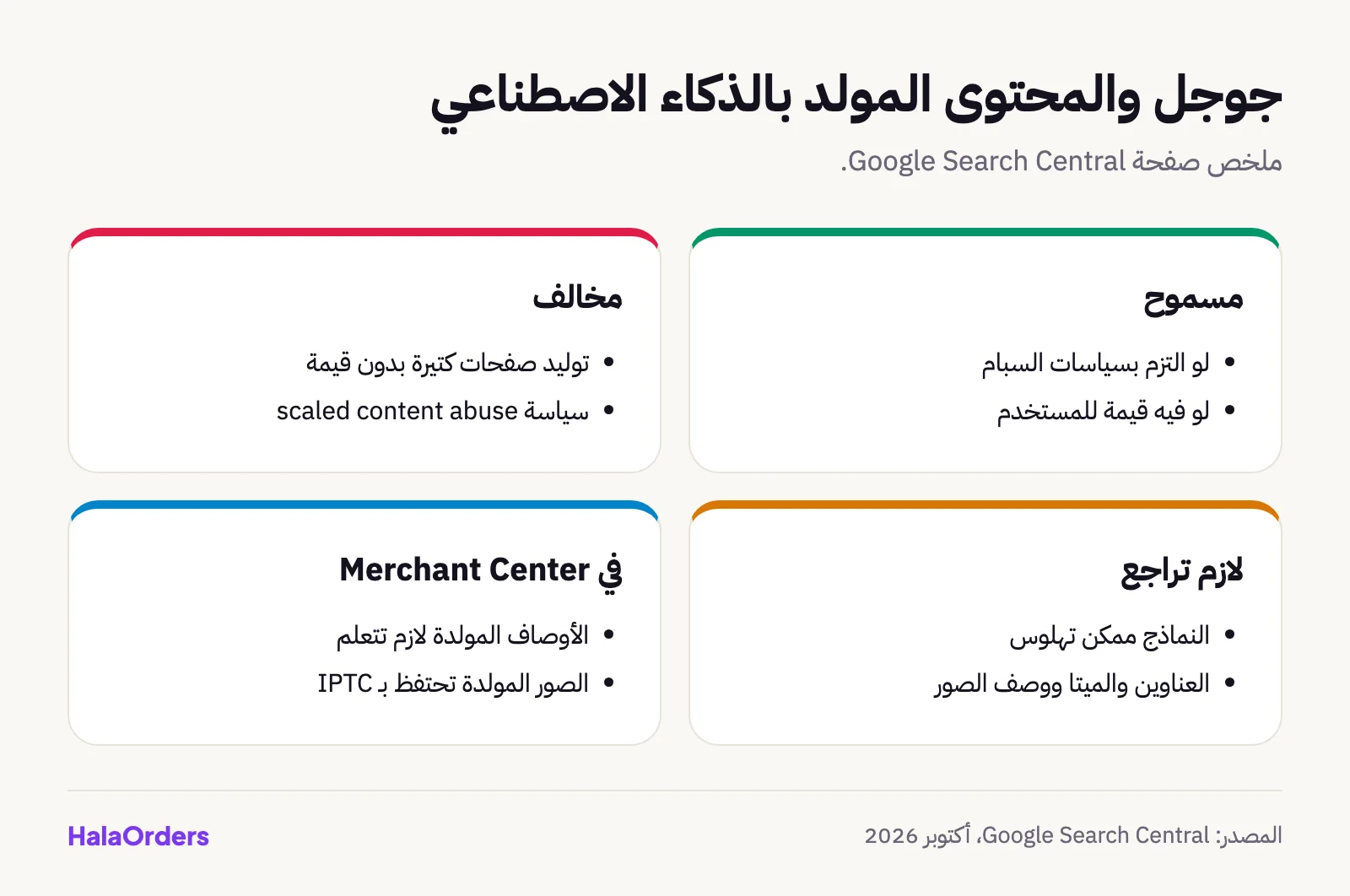
According to Google Search Central's page on AI-generated content:
- Google doesn't ban generated content, but it must comply with Search Essentials and the spam policies.
- Using AI tools to generate many pages without adding value for the user may violate the "scaled content abuse" policy.
- Models predict a likely sequence of words and don't retrieve facts, so they can hallucinate, and you must check the information.
- Also review the meta, the titles and the image descriptions (alt), because they appear in search results.
And in Google Merchant Center, according to the same page, AI-generated product titles and descriptions must be specified separately and marked as AI-generated.
So the practical rule: write for a real customer, and don't publish 100 pages made from one template.
Copywriting tools: Jasper, Hypotenuse and ChatGPT
This information comes from the official websites in October 2026.
| Tool | What it does | Best for | Price and trial | Arabic |
|---|---|---|---|---|
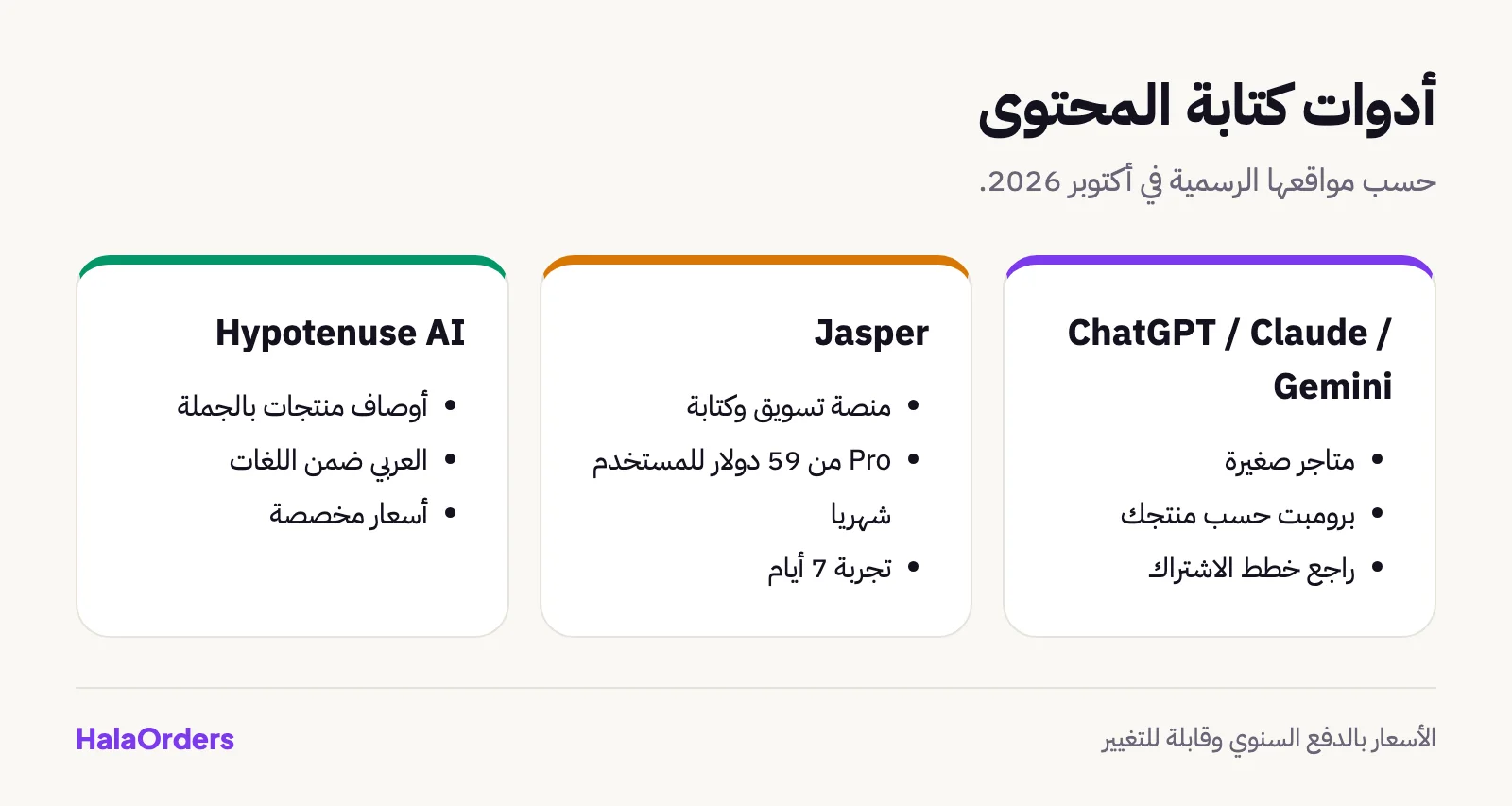
| ChatGPT / Claude / Gemini | General text, tailored by the prompt | Small and medium stores | Free and paid plans; check the website | Handles Egyptian Arabic to varying degrees |
| Jasper | A marketing and writing platform with Brand Voice | Marketing teams | Pro from 59 dollars per user a month billed yearly, with a 7-day trial | Says 30+ languages; Arabic isn't confirmed |
| Hypotenuse AI | Bulk product descriptions, meta and captions | Stores with a large catalog | A free trial and custom pricing | Arabic is among the supported languages |
How do you choose?
- A store with under 100 products: ChatGPT, Claude or Gemini is enough, and you save the subscription money.
- A catalog of thousands: dedicated tools (Hypotenuse, for example) offer bulk writing and connections to product systems, but their pricing is custom and usually requires booking a demo.
- Before buying: test with 5 real products and check the style and accuracy in Arabic.
How do I write 100 descriptions with AI without them looking alike?
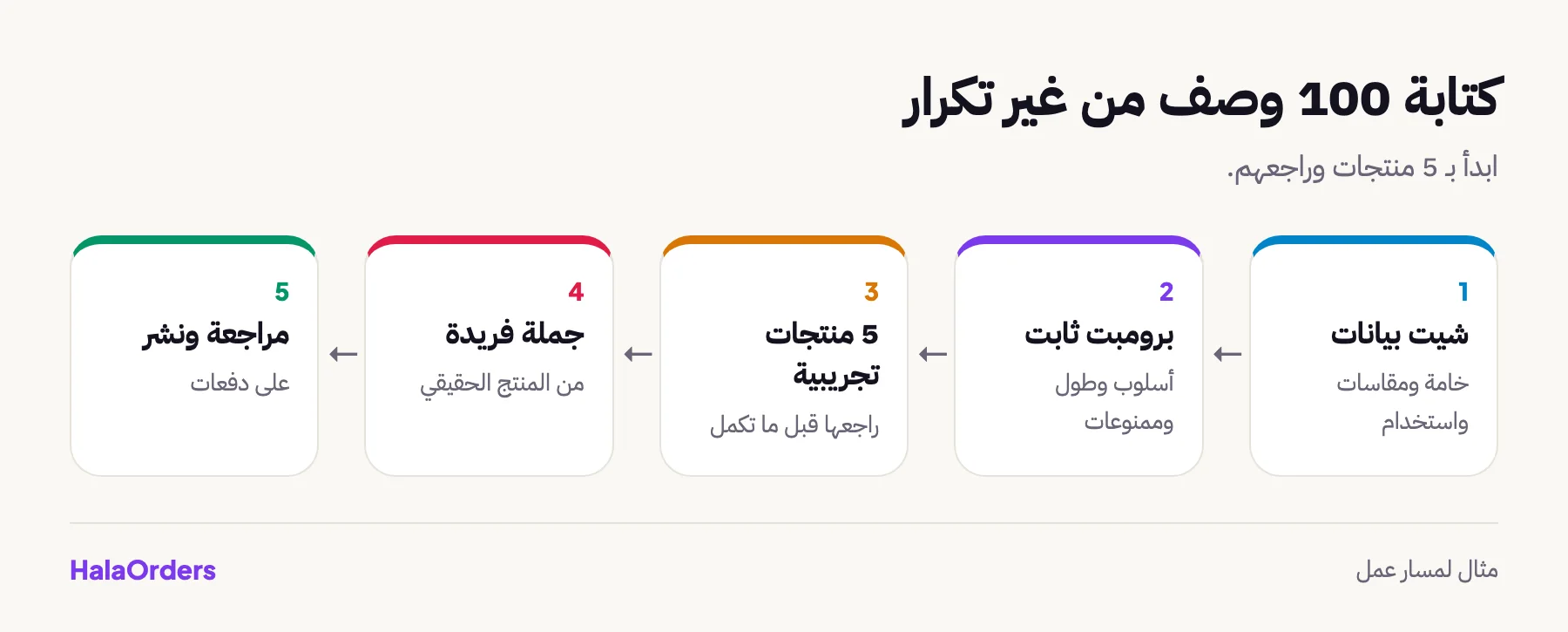
- Prepare a sheet (Excel or Google Sheets) with a column for each real fact: product name, material, sizes, colors, use, price, exchange policy.
- Write a fixed prompt that sets the style, the length and the forbidden information.
- Generate 5 products first and review them before continuing.
- Add a unique sentence of your own to each description (a use, a story, a detail).
- Review each description by hand and compare it with the real product.
- Publish in batches and watch the performance.
A ready prompt to copy
You are a copywriter for an Egyptian store. Write a product description in simple Egyptian Arabic, 60 to 90 words.
Use only the information below, and don't add any information that isn't listed:
- Product: [product name]
- Material: [material]
- Available sizes: [sizes]
- Use or occasion: [use]
- Main feature: [feature]
Write a short paragraph, then 3 bullet points, and finally one sentence about exchanges: [exchange policy].
Don't use phrases like "the best on the market" or "unmatched quality".
If you want to try several wordings for the title and the ad, read ChatGPT and Claude for your store.
Information you shouldn't leave to AI
- Medical or health claims (for example "treats...").
- Guarantees or certifications.
- Numbers or percentages you don't have.
- Comparisons with competitors' products.
This last condition matters because the Egyptian Consumer Protection Law (181 of 2018) places obligations on advertisers, and misleading information can make you liable. Check the official text or consult a specialist.
How do I avoid duplicate descriptions?
Duplicate descriptions happen when you copy the supplier's description or use the same template for 100 products. Google usually tries to show one version of similar content, so your store may not appear if its description is the same as others.
- Vary the opening of each description: start with a question once, a situation once, a feature once.
- Add a detail from the real product (the stitching color, the scent of the packaging).
- Vary the titles: don't give all titles the same format. In Merchant Center the title can be up to 150 characters; put the most important part in roughly the first 70.
- Don't copy from the supplier or from another store.
HalaOrders and content
HalaOrders is an Egyptian platform for building online stores and landing pages. It has no AI writing feature, so you write with an outside tool and paste into the dashboard. What helps you:
- Products with variants and a full description, and photos converted to WebP automatically.
- A blog in the store where you publish articles that support SEO.
- Landing pages with a visual editor for writing an offer for a single product.
- Google Merchant Center: the feed relies on product data, so every well-written description helps you.
- A/B testing where you can try several wordings of the headline.
And see the plans.
How do I review a generated description before publishing it?
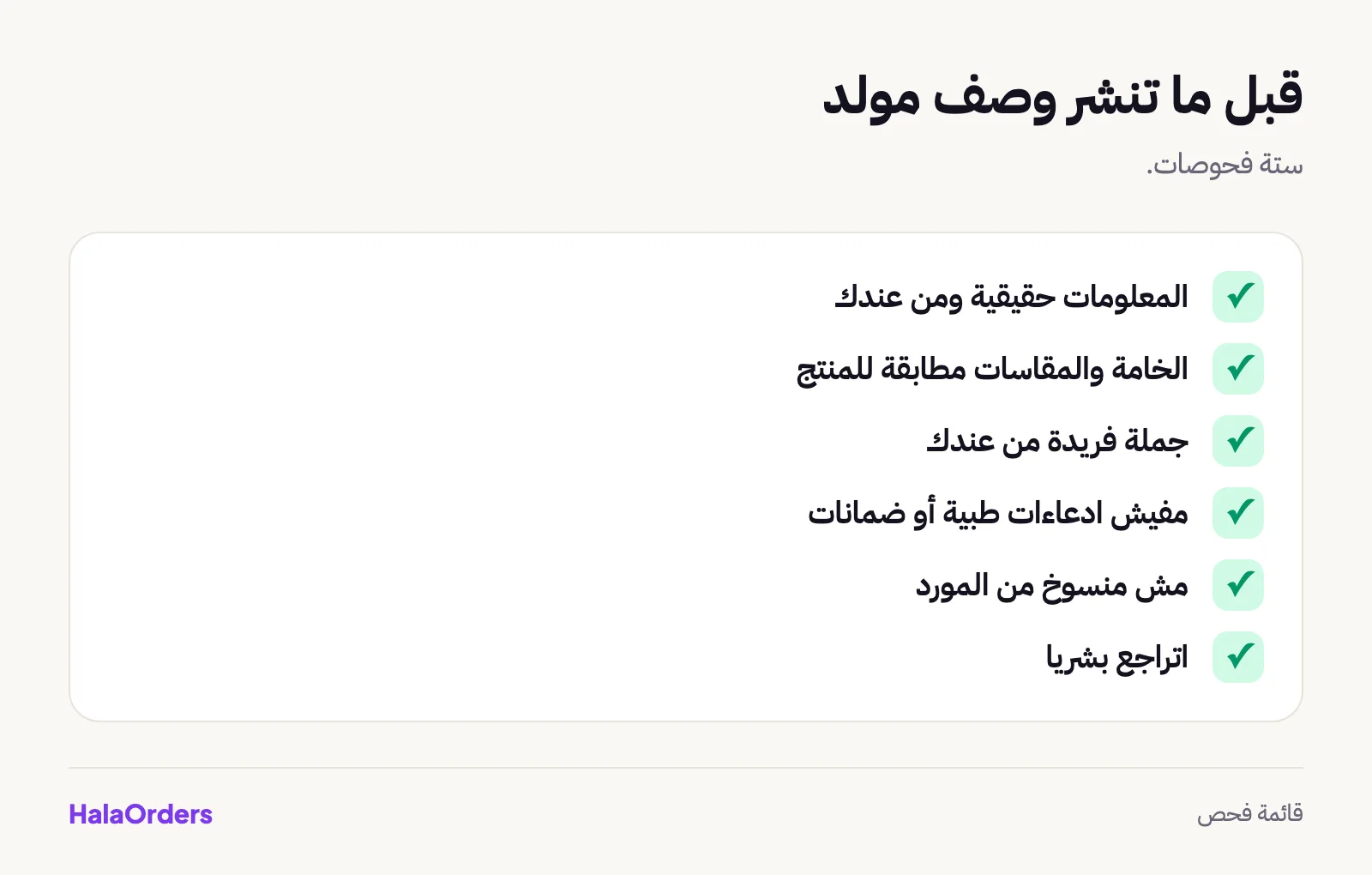
Review is the difference between a description that sells and one that brings you returns. Take 5 minutes per product and check:
- The information: do the material, sizes and colors match the product in front of you?
- The dialect: does it read like you talking to a customer on WhatsApp? If it has stiff formal Arabic or phrases like "we offer you the best we have", a machine wrote it.
- The promises: remove every sentence with "guaranteed" or "100%" that you can't prove.
- The numbers: dimensions in centimeters, the price and durations written correctly.
- The meta: the page title and search description aren't duplicated between two products.
And if you have sizes or a size chart, enter them yourself, because AI often gets numbers wrong.
The bottom line
AI saves you time on phrasing, but it isn't a substitute for correct information. Start with a sheet of real data and a fixed prompt, generate 5 products and review them, and add a sentence of your own to each description. Google isn't against generated content, it is against valueless content in bulk.
Frequently asked questions
Does Google penalize AI-written content?
Not specifically. According to Google Search Central, generated content must follow the spam policies, and generating many pages without value for the user can violate the scaled content abuse policy. So the problem is the lack of value, not the use of the tool.
How do I write a product description with ChatGPT?
Give it real information (material, sizes, use, exchange policy), set the style and length, and tell it not to add information that isn't listed. Generate one description or 5 first and review them yourself before continuing with the rest of the catalog.
How much do Jasper and Hypotenuse cost?
According to their websites in October 2026: Jasper's Pro plan starts at 59 dollars per user a month billed yearly, with a 7-day trial. Hypotenuse AI has a free trial and custom pricing by plan, with Arabic among its supported languages.
Should I mark a description as written by AI?
In Google Merchant Center, according to Google Search Central, AI-generated product titles and descriptions must be specified separately and labeled. And if you use generated images, their metadata (IPTC) must be preserved. Read each platform's terms.
How do I avoid duplicate descriptions?
Don't copy the supplier's description, generate from real data for each product, vary the opening, and add a unique sentence from the real product. Start with 5 trial products and review them before applying the template to the rest.