It is 11 p.m., you have 40 products still without descriptions, a message from a customer asking about an exchange since the morning, and an ad that has to go out tomorrow. That is a normal day for any merchant. Using ChatGPT in e-commerce can finish half of that work in an hour, as long as you know how to write the request correctly and review the result.
In this article we won't tell you "AI will change your life". We will give you ready prompts to copy for product descriptions, ad hooks, customer replies and the exchange policy, how to ask for Egyptian Arabic, how to review the output, and what you should never put into the tool.
In short: you can use ChatGPT, Claude or Gemini in your store to write drafts: product descriptions, ad hooks, customer replies and policies. The rule: give it real information about the product and the customer, ask for a specific tone and length, check every number and size yourself before publishing, and don't upload customer data (phone numbers or addresses) into any tool.
What can I use ChatGPT for in my store?
ChatGPT, Claude and Gemini are AI assistants that write, summarize and rephrase from a written request. For your store, that means you get a draft in seconds instead of starting from a blank page.
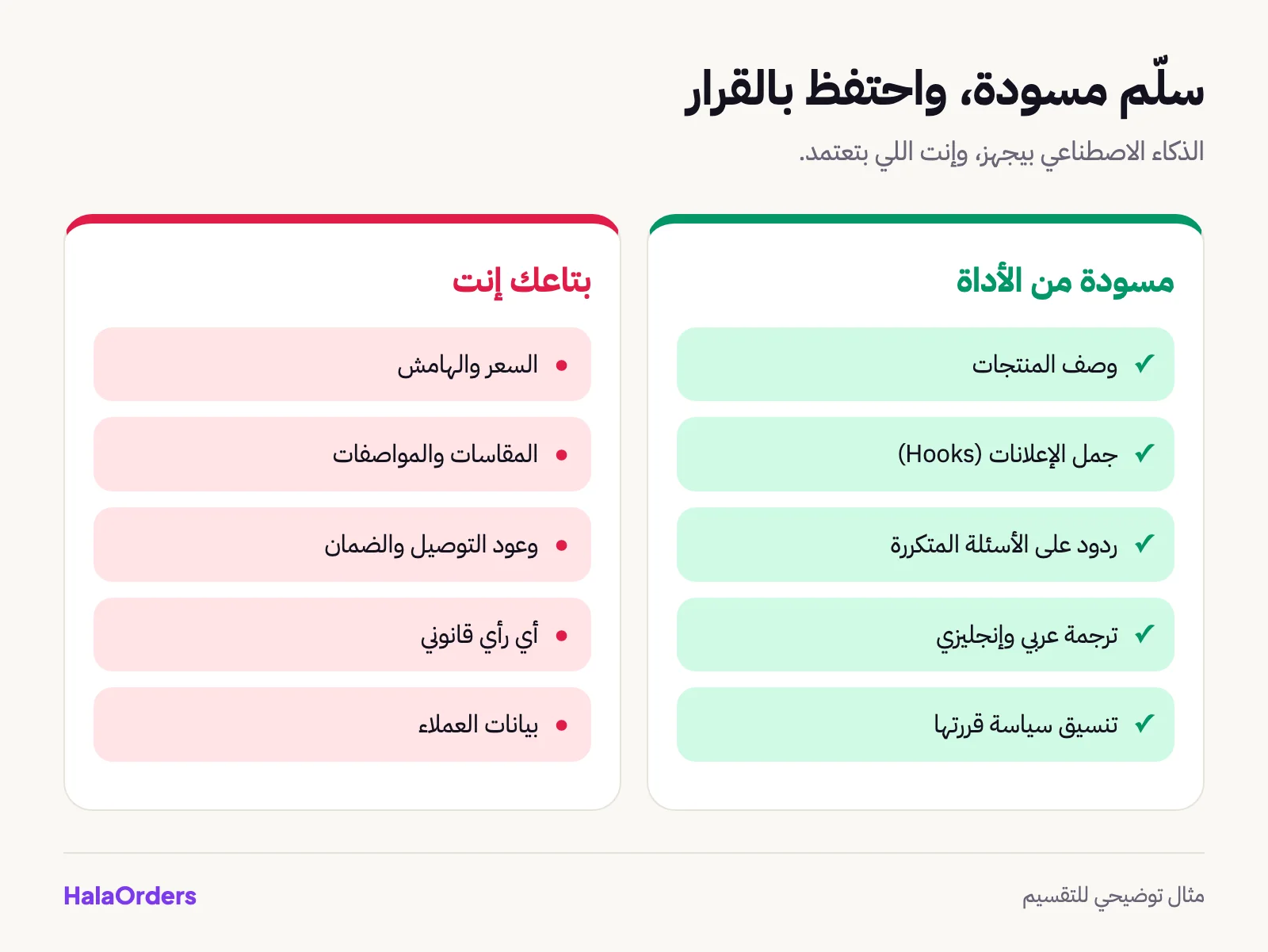
- Good for: product descriptions, titles, ad hooks, content ideas, replies to frequent questions, a draft policy, translation between Arabic and English.
- Not on its own: setting the price, writing sizes and specifications from imagination, promises (delivery within 24 hours), anything legal, and any customer data.
And keep in mind: the model can't see your product. It guesses from what you write. So the description that comes out is exactly as good as the information you put in.
How do I write a good prompt?
A good prompt has five things: the role, the product and its details, the customer, the format you want, and what is not allowed.
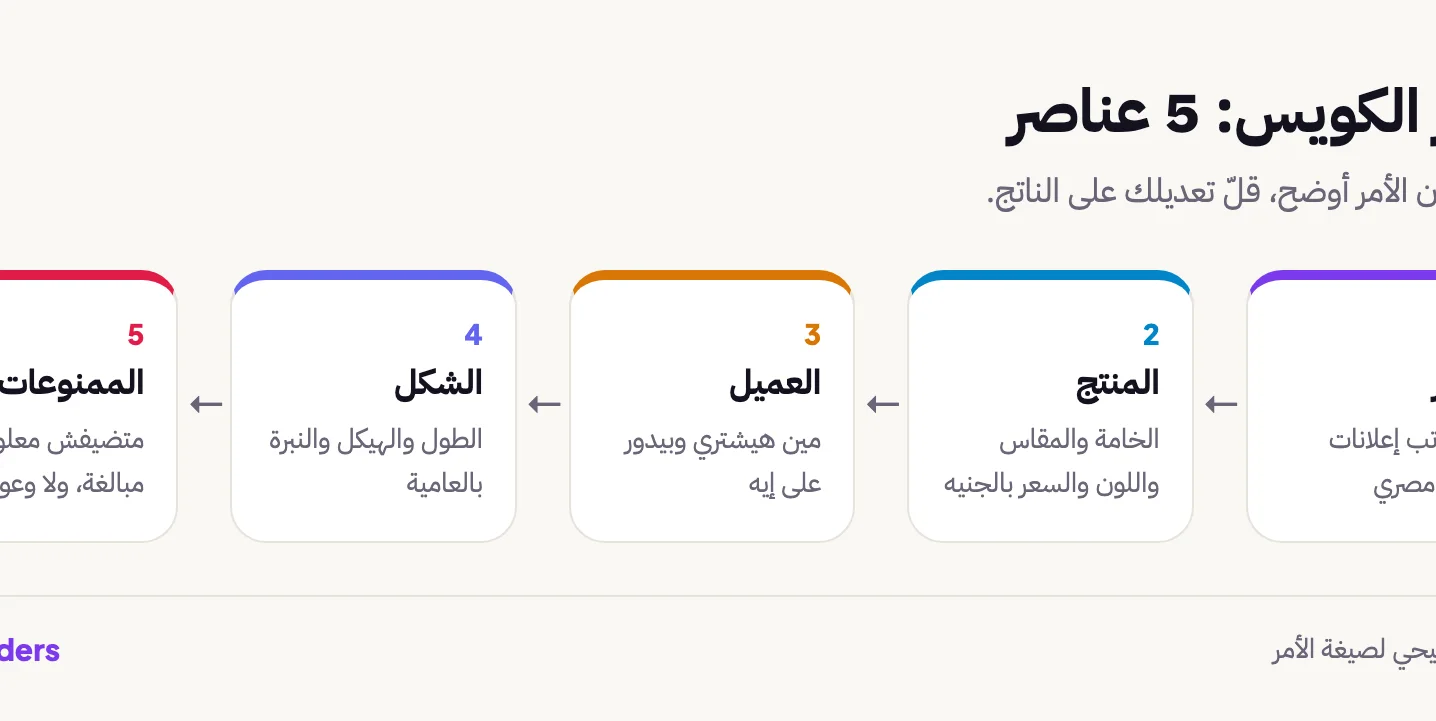
A weak prompt: "write me a description for a bag". A strong prompt looks like this:
You are a copywriter for an Egyptian store that sells women's bags.
Product: a faux leather crossbody bag, beige, 22x15 cm, two pockets and a zip,
priced at 450 EGP.
Customer: a woman aged 20 to 40 looking for a light bag for work and going out.
Write a 60 to 80 word description in simple Egyptian Arabic, without exaggeration.
Not allowed: adding specifications that aren't listed above, or the phrase "best in Egypt".
Notice: we wrote the size and material ourselves and asked it not to add anything. That is the most important line.
How do I write product descriptions quickly?
Try this prompt, and change the fields in brackets:
Write a product description for an Egyptian online store.
Product: [name], material: [..], available sizes: [..], colors: [..],
price: [..] EGP, use: [..].
Structure: a catchy title, a short paragraph (30 words), 4 feature bullets, one line about exchanges.
Tone: friendly and simple, in Egyptian Arabic, without exaggeration.
Write only the information above, and if something is missing write [needs confirmation].
The "[needs confirmation]" line makes the model flag what it isn't sure about instead of making it up. And the description is directly tied to your order rate, so read the conversion rate guide.
How do I write ad hooks for Facebook and TikTok?
Write 10 opening lines (hooks) for a 15-second video ad for the product: [product].
Customer: [description]. The problem it solves: [..]. Price: [..] EGP, cash on delivery.
Mix: a question, a number, a problem, before and after.
Everyday Egyptian Arabic, no medical promises or exaggerations, and each line under 12 words.
After choosing 2 or 3 lines, try them in separate ads and compare the results. For organized testing, use A/B testing for landing pages or compare the ads inside Meta. And in landing pages for Facebook and TikTok ads there is more detail on the page the ad leads to.
How do I reply to customers with the right prompt?
You are a customer service agent for an Egyptian clothing store.
The customer's message: "The dress arrived too small, I want to exchange it".
Our exchange policy (an example, use your own): exchanges within 14 days of delivery, the item in its
original condition, the customer pays shipping if she changed her mind, and we pay it if the fault is ours.
Write a short, polite reply in Egyptian Arabic with two clear steps, without over-apologizing.
What you need to know: you must enter the real policy yourself. If you let the model guess it, it will invent a policy. And again, don't send the reply before reading it.
Can I write the exchange and privacy policy with AI?
Yes as a language draft, not as a legal text. Ask it to format the policy you decided on, not to decide it. If you are talking about consumer rights under Egyptian law, check an official source or a lawyer, and we are publishing a dedicated article on the exchange policy.
Format this exchange policy as 5 clear points in Egyptian Arabic:
- Period: [..] days from delivery
- Condition: [..]
- Who pays shipping: [..]
- How to request it: [..]
- Exceptions: [..]
Don't add any condition that isn't listed.
Do the three tools understand Egyptian Arabic?
All three write Arabic and understand the dialect, but the quality of Egyptian Arabic varies from version to version and request to request, and there is no official source that measures it. So it is best to try the same prompt on all three and compare for yourself.
| Tool | Company | Free plan | What we recommend |
|---|---|---|---|
| ChatGPT | OpenAI | Yes, with usage limits | Try the same prompt and compare the result |
| Claude | Anthropic | Yes, with usage limits | Try the same prompt and compare the result |
| Gemini | Yes, with usage limits | Try the same prompt and compare the result |
Plans and limits change quickly, so check the pricing page on each website before relying on a tool.
If you want to make sure of the dialect: add a line to the prompt like "write the way an Egyptian merchant replies to a customer on Messenger" and include a sentence or two of your own as an example.
How do I review the output before publishing it?
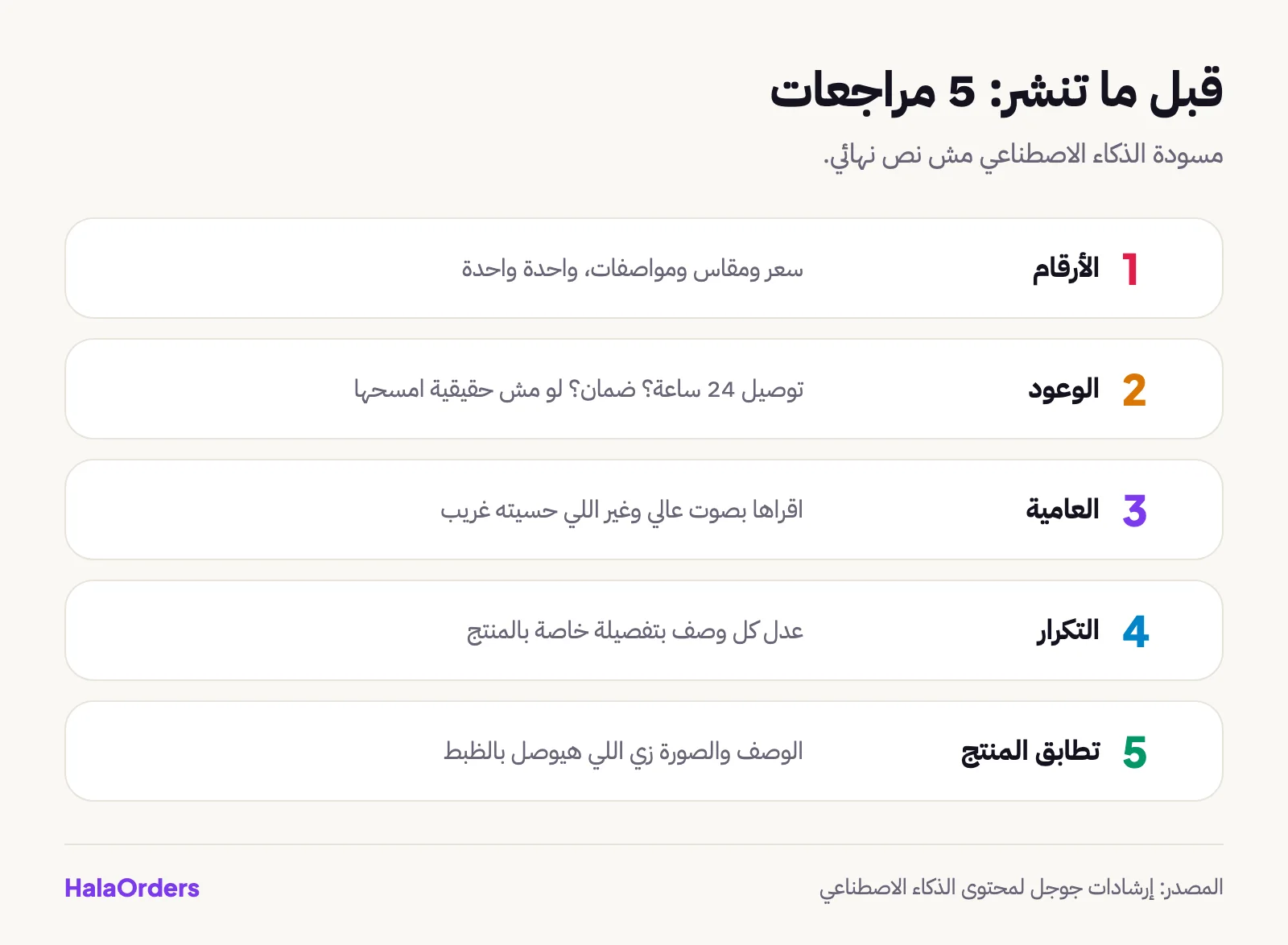
- Numbers, sizes and price: check them one by one.
- Promises: "24-hour delivery" or "one-year guarantee", if they aren't true, delete them.
- The dialect: read it out loud, and if it sounds odd, change it.
- Repetition: if all the descriptions look alike, Google and customers will notice. Edit each description with a detail specific to the product.
- Matching the product: the description and photo must match what will arrive.
As for Google: Google's guidelines say using AI in content isn't banned, but generating lots of pages with no value for the reader can violate its spam policy (scaled content abuse). So use it as a draft, review it and add real information.
What must I never put into ChatGPT?
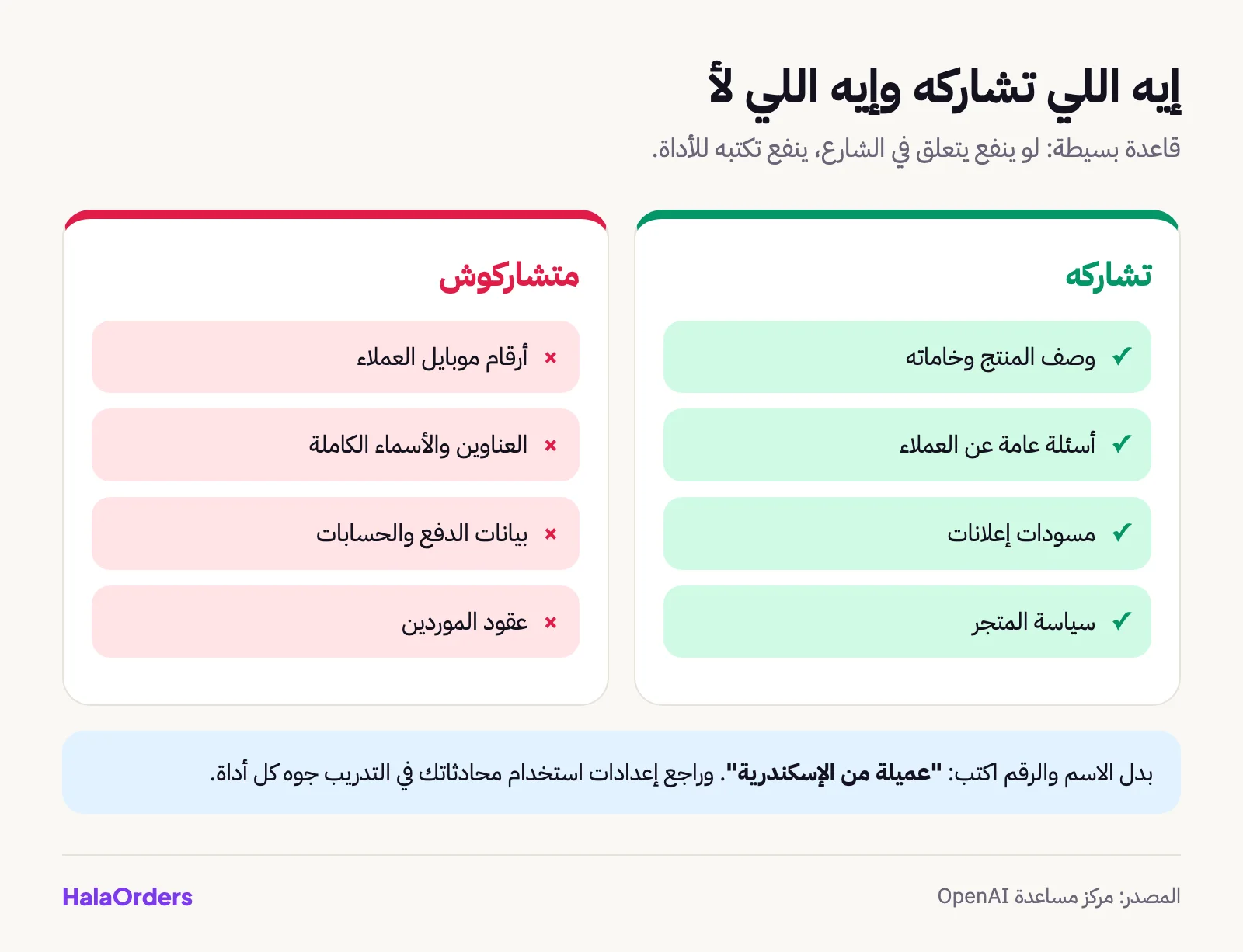
- Don't put in: customers' phone numbers, addresses, full names, payment details, your bank account numbers or supplier contracts.
- Use instead: "a customer from Alexandria" rather than the name and number.
- Check the privacy settings: in ChatGPT, OpenAI offers an "Improve the model for everyone" setting in Data controls; if you turn it off, new conversations aren't used to train the model. Check the settings of every other tool yourself.
As a merchant handling customer data, the responsibility is yours.
How do I work on 40 products at once?
If you have a large catalog, don't write a prompt for each product from scratch. Make a fixed prompt with the structure, tone and restrictions, and then change only the product data each time. You can also give the model a table with 5 products in one message and ask for a description for each with the same structure:
Here is the data for 5 products in a table (name | material | sizes | price).
Write a description for each product with the same structure as above, and make each description start
with a different sentence from the others. Mark any information not in the table with [needs confirmation].
Working in batches saves time but raises the risk of similar descriptions, so review each batch and edit the details specific to each product. Start with the first 5 products, compare the result with your own writing, and adjust the prompt before continuing with the rest.
How does HalaOrders help?
HalaOrders is an Egyptian platform for building online stores and landing pages. It has no AI writing feature, so you write your text with the tool you like and put it in the store. The platform does the other part:
- Add the descriptions and photos to your products, with variants (sizes and colors) and stock.
- Landing pages where you put the ad hooks you chose, with the order form, and an A/B test that picks the best one.
- A store blog to publish articles (review them yourself before publishing).
- Telegram notifications and order emails to customers.
- Human support in Arabic and English.
See the features and the plans, and to compare with other tools: AI tools for e-commerce. And if photos are the problem: AI product photography.
The bottom line
Treat ChatGPT, Claude and Gemini as an assistant that prepares a draft for you. Write the prompt with five parts, enter the real information yourself, ask it to flag what it isn't sure about, and check the numbers, promises and dialect before publishing. And don't upload customer data.
Frequently asked questions
How do I use ChatGPT to write product descriptions?
Give it the product name, material, sizes, price and target customer, and ask for a specific structure (a title, a short paragraph and bullets) in Egyptian Arabic. Tell it to write only the information you gave it and to flag what is missing. Then check every number before publishing.
Does ChatGPT understand Egyptian Arabic?
It understands it and writes it to different degrees depending on the version and the request, and there is no official measure. Try the same prompt on ChatGPT, Claude and Gemini, and add an example of your own writing to the prompt so the tone comes out close to your store's.
Does Google penalize AI-written content?
Google's guidelines say using AI is not banned in itself. But generating lots of pages with no real value for the reader can violate its spam policy. Write a draft with the tool, add real information about your product, and review it.
What shouldn't I upload to AI tools?
Customers' phone numbers, addresses and names, payment details, bank accounts and supplier contracts. Use general descriptions instead. And in ChatGPT you can turn off "Improve the model for everyone" in Data controls so your conversations aren't used for training.
Which tool should I use: ChatGPT, Claude or Gemini?
All three have a free plan with limits, and the versions keep changing, so there is no fixed answer. Try the same prompt on all three with your product and customer, compare the dialect and accuracy, and use the one whose result needs the least editing.