"Should I build the store on WordPress? Hire a developer to build it from scratch? Or subscribe to a ready-made platform?"
This question gets asked in almost every merchants' group, and the answers are always very enthusiastic and very contradictory. One person says "WooCommerce is free", another says "platforms take your money every month", and a third says "build it custom so it's yours".
The truth is that each of the three is right for one type of merchant and very wrong for another. In this article we compare them honestly, by the real cost (not the one in the ad), time and risk, and at the end there is a simple decision tree to follow.
In short: if you are a merchant, not a developer, and want to sell within days with Egyptian payments and shipping ready, a ready-made platform is usually the best fit. WooCommerce suits you if you have a regular developer and need lots of customization, and custom development is for a completely different business model with a budget and a technical team behind it.
The three options in a minute
- A ready-made store platform (SaaS): you subscribe, choose a design, add your products and sell. Hosting, security, updates, payments and shipping are the platform's responsibility.
- WordPress + WooCommerce (self-hosted): free, open-source software, but you get the hosting, install the theme and plugins, and keep up with updates and security.
- Custom development: a developer or agency builds a store from scratch, exactly to your needs. You own the code, and you carry everything.
A quick comparison
| Ready-made platform | WooCommerce | Custom development | |
|---|---|---|---|
| Launch time | Days | Weeks | Months |
| Upfront cost | Very low | Medium | High |
| Monthly cost | A fixed subscription | Hosting, plugins and a developer | Hosting and a maintenance team |
| Technical skills needed? | No | Some to a lot | No, but you need to manage developers |
| Security and updates | On the platform | On you | On you |
| Local payment and shipping | Usually ready | Plugins, and quality varies | Has to be built |
| Flexibility and customization | Within the platform's limits | High | Unlimited |
| If the developer disappears | No problem | A medium problem | A big problem |
The real cost: the iceberg under the water
The biggest mistake in comparisons is that people compare only the visible price. WooCommerce is "free", but a store that actually works needs:
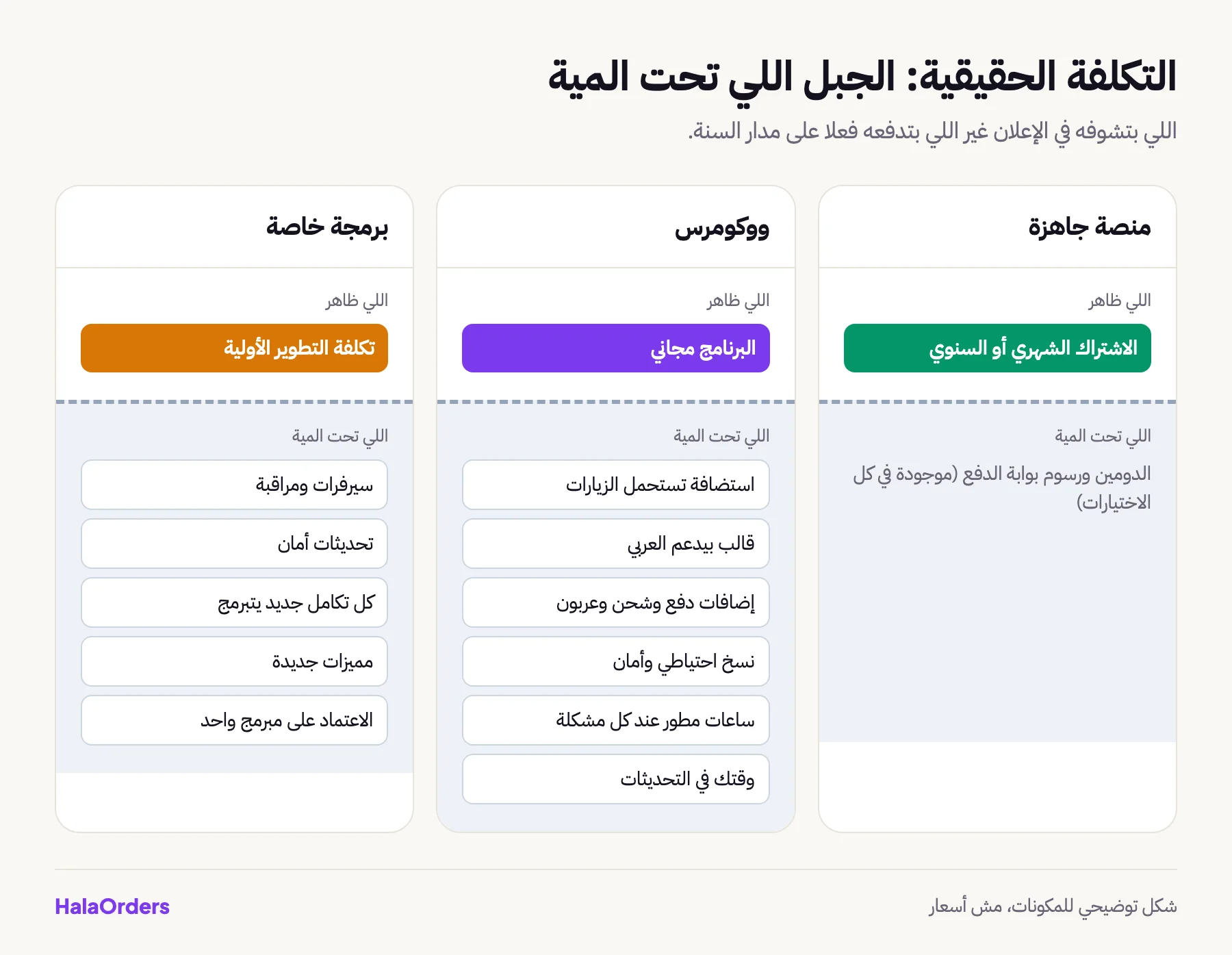
With WooCommerce:
- Good hosting: very cheap hosting gets slow when an ad brings traffic, which is exactly when you need it.
- A paid theme: you will probably need a theme that properly supports Arabic and right-to-left text.
- Paid plugins: the payment gateway, the shipping company, delivery fees per governorate, cash-on-delivery deposits, invoices, backups, caching, security. Each usually has an annual subscription, often in dollars.
- A developer: even if you can install things yourself, you will need someone when something breaks after an update, or when two plugins clash.
- Your own time: the hours you spend on updates and problems are hours you aren't selling.
With custom development:
- The build cost is the big number everyone sees, but maintenance is what surprises people: security updates, changes, new features, servers. And every new payment gateway or shipping company has to be built from scratch.
With a ready-made platform:
- The subscription is most of the cost, and you know it from the start. What can add to it: the domain, and the payment gateway fees (which exist in every option anyway).
Time: when is your first order?
In commerce, the time you spend building the store is time your competitor spends selling. Here is a rough estimate based on typical projects for a store with 30 to 50 products:
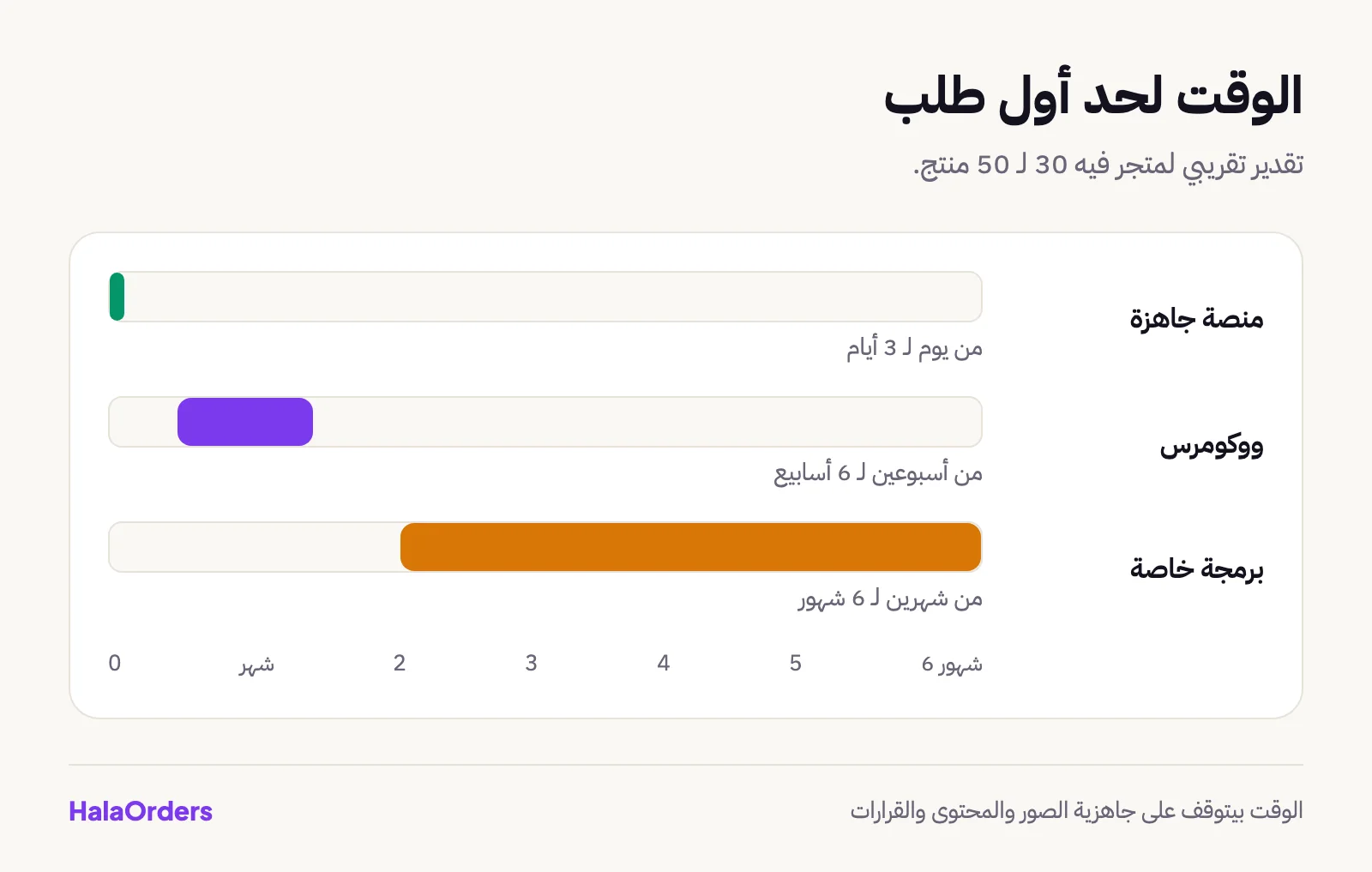
And that time isn't only before launch. Think of the technical work every month after launch: updates, problems, new plugins. On a ready-made platform that is close to zero. On WooCommerce it is hours every month. On a custom store it depends on the developer.
Security: the part nobody thinks about until it happens
WordPress runs about 40% of all websites according to W3Techs, which is both an advantage (a big community and lots of plugins) and a drawback (a favorite target for attacks). Patchstack's WordPress security report recorded 11,334 new vulnerabilities discovered in 2025 alone, up 42% from the year before, and 91% of them were in plugins, with only 6 in WordPress core.
So every plugin you install to add a feature also adds a possible vulnerability that someone has to watch and update. In a store holding customers' data, addresses and phone numbers, that is not a small matter.
On a ready-made platform, the platform's team handles security, updates and backups for every store at once.
The decision tree
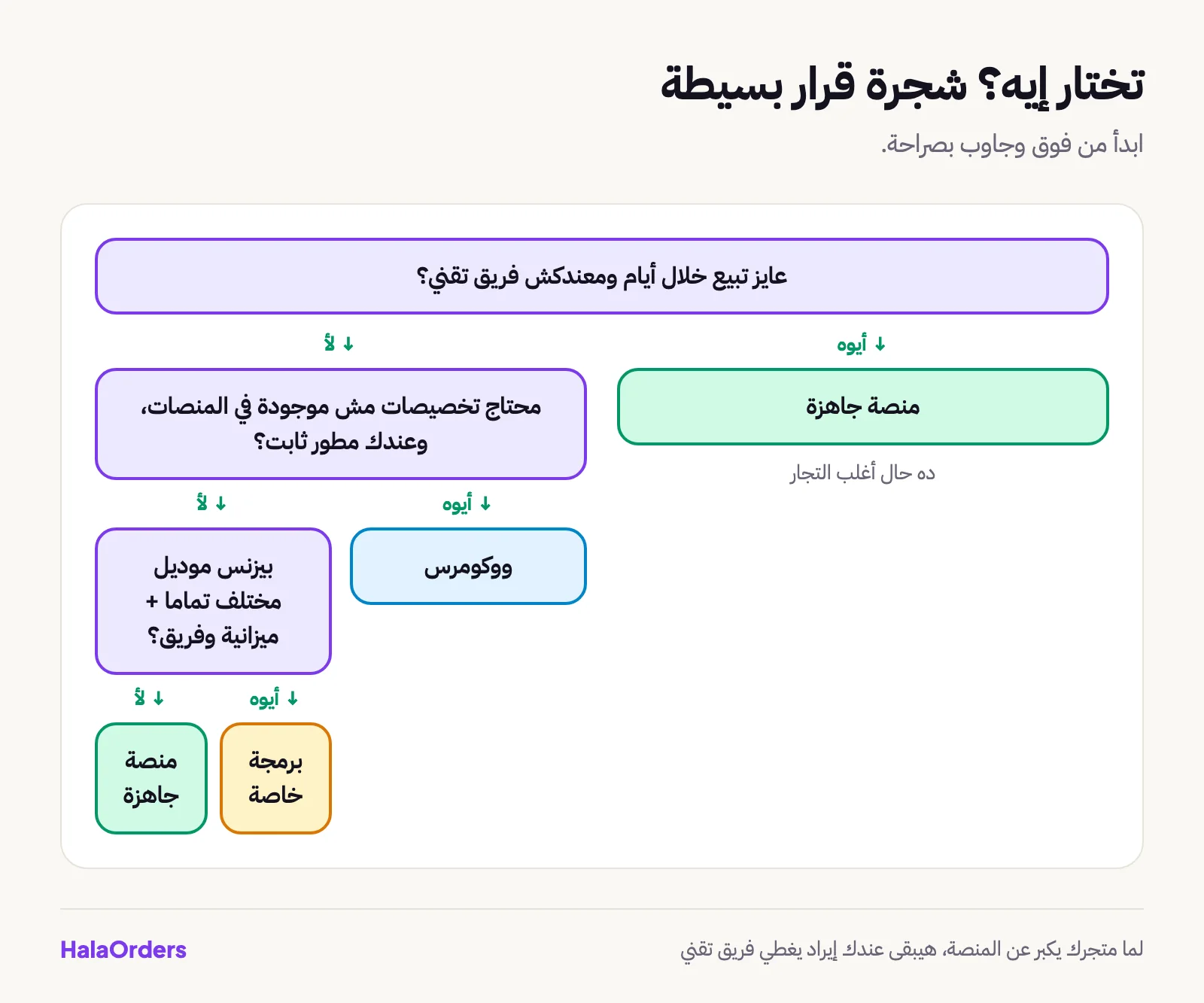
In plain words:
- Choose a ready-made platform if: you are a merchant, not a developer, you want to start selling this week, your products are typical (clothing, decor, beauty, handmade, electronics...), and you need Egyptian payments and shipping working from day one. That describes most merchants.
- Choose WooCommerce if: you have a regular WordPress developer you trust, you need customization the platforms don't offer, and you are ready to carry the maintenance.
- Choose custom development if: your business model is very different (for example a marketplace for many merchants, very complex pricing, or integration with an internal system), and you have a budget for ongoing development and maintenance, or an in-house technical team.
10 questions to ask any platform before you subscribe
Not all ready-made platforms are the same, especially for the Egyptian market. Before you choose, ask:
- Does cash on delivery support a deposit? Or is it all cash or all online?
- Are InstaPay and Vodafone Cash available? And does the customer upload the receipt on the order, or send it on WhatsApp?
- Is there a card payment gateway? And what are its fees?
- Can the delivery fee be set for each governorate and city?
- Is there an integration with a shipping company, or will you copy the details by hand?
- Is Arabic done right? Text direction, fonts, numbers. And a bilingual store if you need one?
- Are there landing pages for ads? And can you test several designs?
- Can you connect your own domain, with SSL?
- Are pixels and measurement tools easy to add?
- Does support reply in Arabic, and quickly? Send a question before you subscribe and see when they answer.
And one more important question: if you want to leave, can you take your data? Your products, customers and orders belong to you.
If you are moving from one platform to another
If you already have a working store, moving needs planning so you don't lose your Google ranking or your customers:
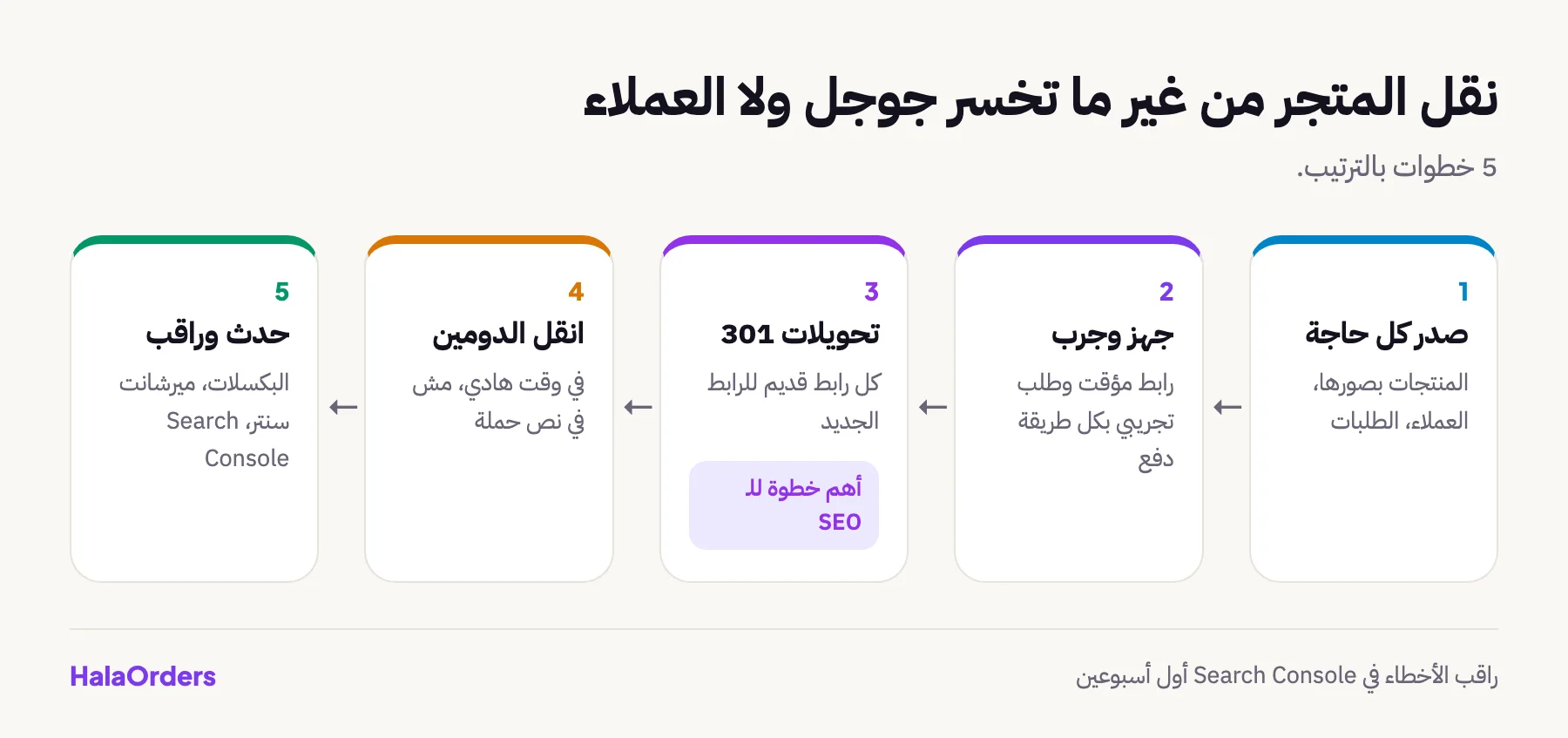
- Export everything before changing anything: products with their photos, customers, past orders.
- Set up the new store and test it fully on a temporary link. Place a test order with every payment method.
- Redirects (301): every old product URL must redirect to the new one, or you will lose the visits coming from Google.
- Move the domain at a quiet time, not in the middle of an ad campaign or a season.
- Update the pixels in your ad manager, update Google Merchant Center and Search Console, and watch for errors in the first two weeks.
HalaOrders: a ready-made platform built for Egyptian merchants
We are a ready-made platform, of course, so keep in mind that we are a party to this. But if you decide a ready-made platform is the best fit for you, here are HalaOrders' answers to the ten questions:
- Cash on delivery with a deposit (the delivery fee, a percentage or a fixed amount).
- InstaPay, Vodafone Cash and bank transfer, with the receipt uploaded on the order.
- Paymob for card and wallet payments.
- Delivery fees for each governorate and city, and an integration with Sky Express to create and track shipments.
- An Arabic and English store with full support for text direction.
- Landing pages with ready templates, a visual editor and A/B testing.
- A custom domain with a free SSL certificate.
- Meta Pixel, TikTok Pixel, Google Analytics and Google Merchant Center.
- Team members and permissions if someone helps you with orders.
- Human support in Arabic and English.
You can see every feature on the features page and compare the plans and prices.
The bottom line
There is no "best" choice overall. There is the best choice for your stage. If you are a merchant who wants to sell, a ready-made platform will most likely save you months, money and headaches, and let you focus on the product and marketing. And when your store grows to the point that a platform isn't enough, by then you will have the revenue to cover a full technical team.
And if you are just starting to think about it, read the state of e-commerce in Egypt in numbers to understand the market you are entering.
Frequently asked questions
Is a ready-made store platform or WooCommerce better?
If you are a merchant, not a developer, and want to sell quickly with Egyptian payments and shipping ready, a ready-made platform is usually the best fit. WooCommerce suits you if you have a regular developer, need lots of customization and are ready to carry the maintenance and security.
Is WooCommerce really free?
The software itself is free, but a working store needs hosting, a theme, paid plugins for payments, shipping and deposits, and developer hours for maintenance and updates.
How long does it take to open an online store?
About 1 to 3 days on a ready-made platform, 2 to 6 weeks on WooCommerce, and 2 to 6 months with custom development, for a store with 30 to 50 products.
If I move my store to another platform, will I lose my Google ranking?
Not necessarily, as long as you add 301 redirects from every old URL to the new one, update Search Console, Google Merchant Center and your pixels, and watch for errors in the first two weeks.