If you are thinking about opening an online store in Egypt, or you sell from a social media page and aren't sure whether to grow, the first thing you need isn't a logo or a domain name. You need to understand the market you are entering: where people buy, how they pay, what they use, and what is changing this year.
In this article we collected the most important published numbers on e-commerce and digital payments in Egypt up to the end of 2025, from official sources such as the National Telecom Regulatory Authority, the Central Bank and the Ministry of Communications, and from DataReportal and market research firms. We also tried to turn each number into a practical decision for your store. All the sources are listed at the end of the article if you want to go back to them.
In short: Egypt has about 98 million internet users and about 60 million active mobile wallets at the end of 2025, and the e-commerce market is growing by 12% to 15% a year. Cash on delivery is still between 45% and 70% of orders, so a successful store offers cash, wallets and InstaPay together, and sells mobile first.
The big picture: 98 million Egyptians online
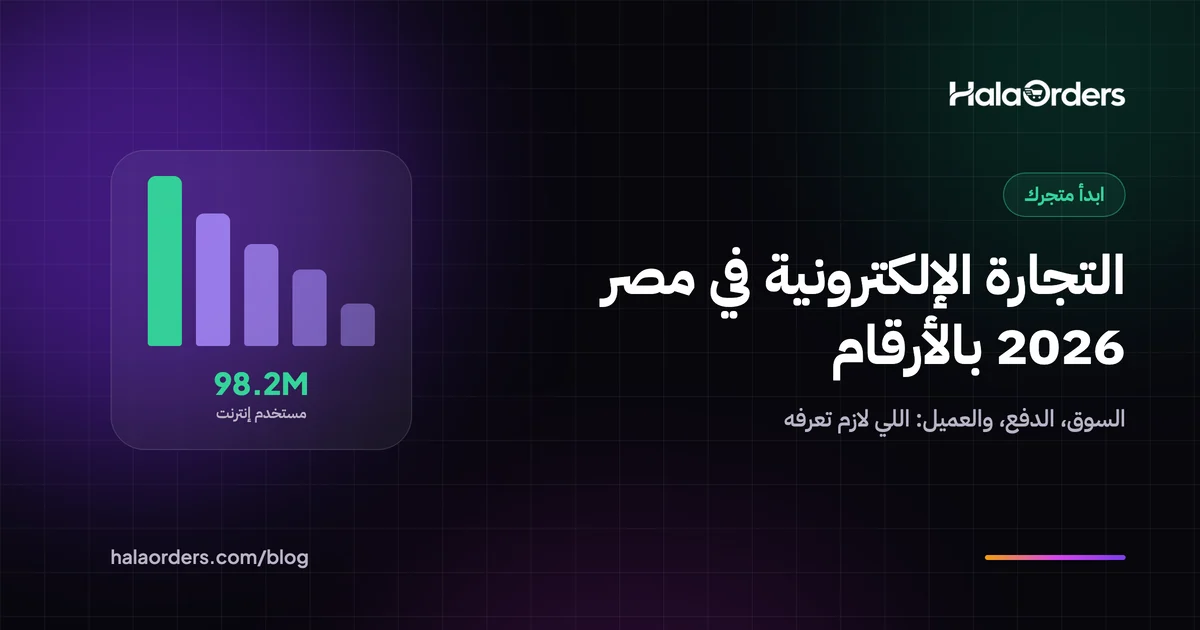
According to DataReportal's Digital 2026 report for Egypt, the number of internet users in Egypt reached about 98.2 million at the end of 2025, a penetration rate of 82.7% of the population. There are about 121 million active mobile connections, more than the population itself, because many people carry two SIM cards.
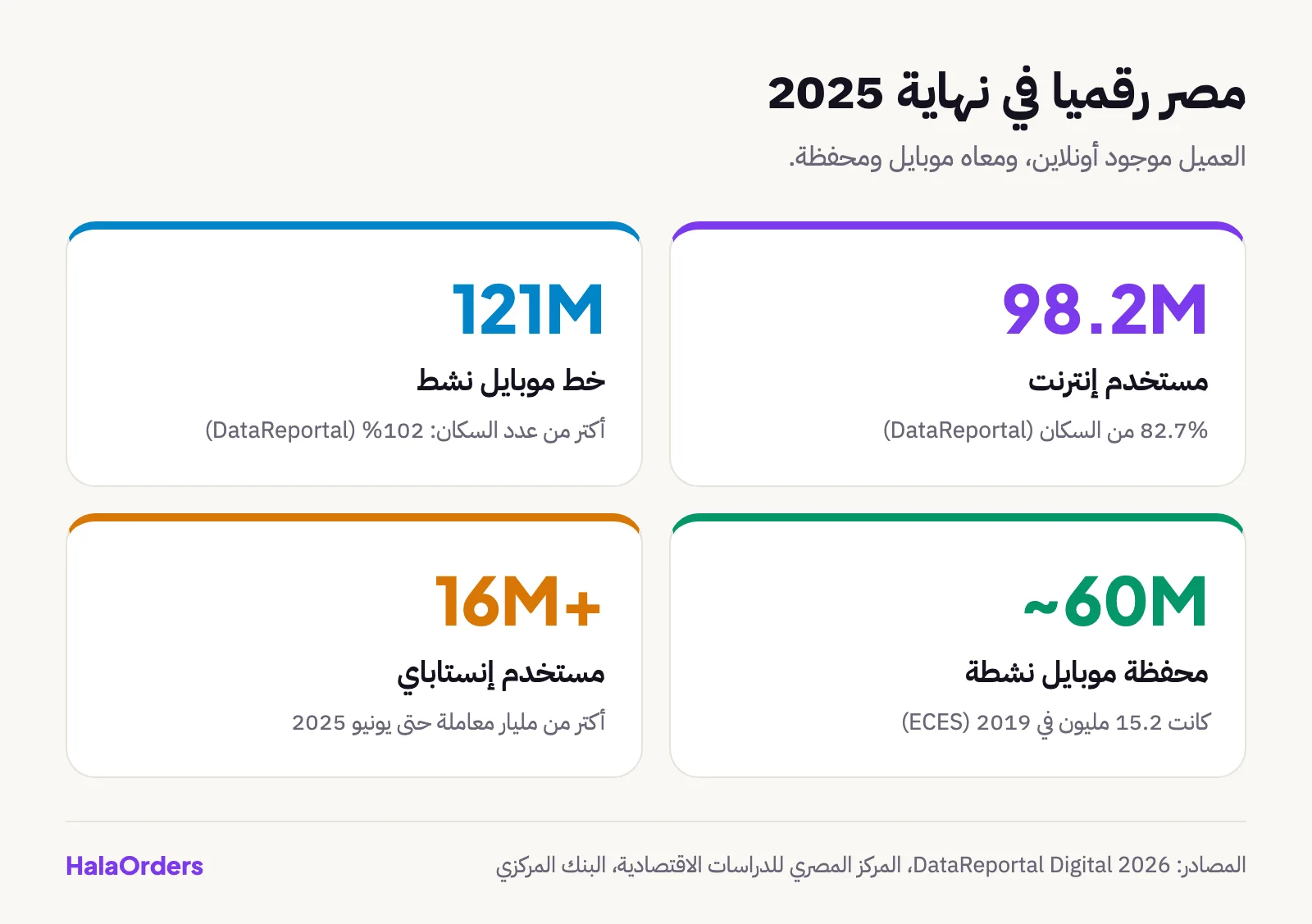
This number means one important thing: your customer is already online, most likely on a phone. The problem isn't reaching them, it is convincing them to buy from you specifically and delivering the order without problems.
Market size: why are the numbers so different?
You will find estimates of the size of the e-commerce market in Egypt starting at 2.3 billion dollars (ECDB's estimate for 2025) and reaching 11.5 billion dollars (Mordor Intelligence's estimate for 2026). The gap isn't a calculation error, it comes from what is being counted:
- Some reports count only product sales (clothing, electronics, home goods...).
- Others add services such as travel booking, food delivery and bill payments.
- And most of them don't count sales closed in Facebook and WhatsApp messages and paid in cash, which is a huge part of the Egyptian market.
What almost everyone agrees on is that the market is growing by 12% to 15% a year. So if your store is growing slower than that, you are actually losing market share even if your numbers are going up.
The phone is the wallet now
The biggest change in the last two years isn't in shopping itself, it is in payments. Look at the growth of mobile wallets:
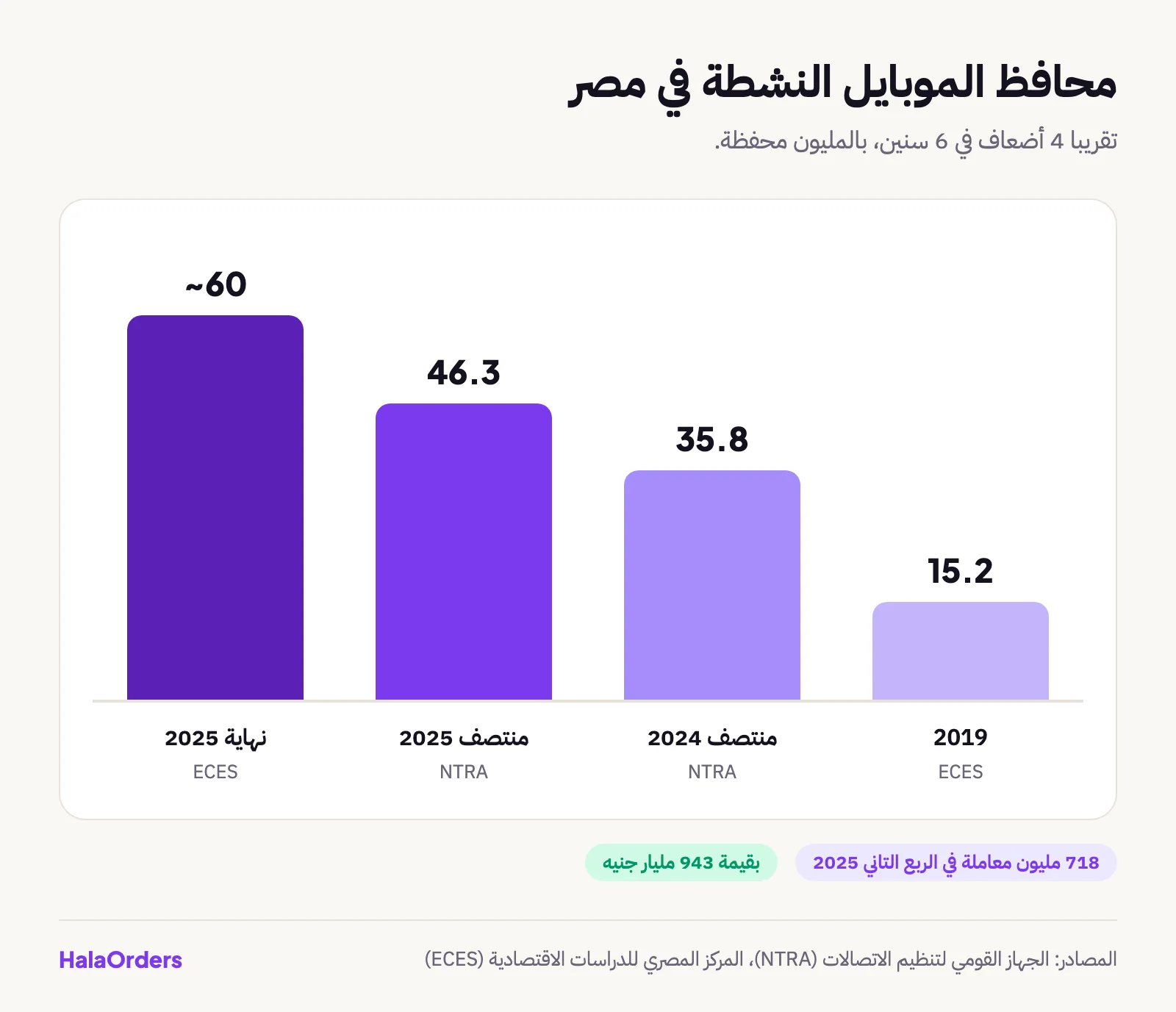
- The National Telecom Regulatory Authority announced that active wallets reached 46.3 million in Q2 2025, against 35.8 million in the same period of 2024, and that these wallets made 718 million transactions worth 943 billion EGP in a single quarter.
- According to the Egyptian Center for Economic Studies, the number reached about 60 million active wallets at the end of 2025, up from only 15.2 million in 2019. That is roughly four times in 6 years.
- InstaPay alone passed 16 million users in mid 2025, with more than a billion transactions. Since April 2025 there has been a 0.1% fee on transfers, and usage hasn't dropped.
What does this mean for your store?
The customer who, three years ago, would only pay cash can now easily transfer the order value or a deposit from their phone in 10 seconds. So if your store still offers cash on delivery only, you are leaving money on the table:
- A customer who pays in advance almost never refuses the delivery.
- The money reaches you before shipping, not a week later when the shipping company settles with you.
- You can easily ask for a deposit on expensive orders or distant governorates.
Cash is still king, but not alone
In 2024 the Ministry of Communications published the results of a somewhat older survey (2021/2022 data) saying that 98.4% of online shoppers preferred to pay in cash. More recent estimates from research firms put cash on delivery at around 45% to 70% depending on how it is measured (by number of orders or by value, and inside Cairo and Alexandria or outside them).
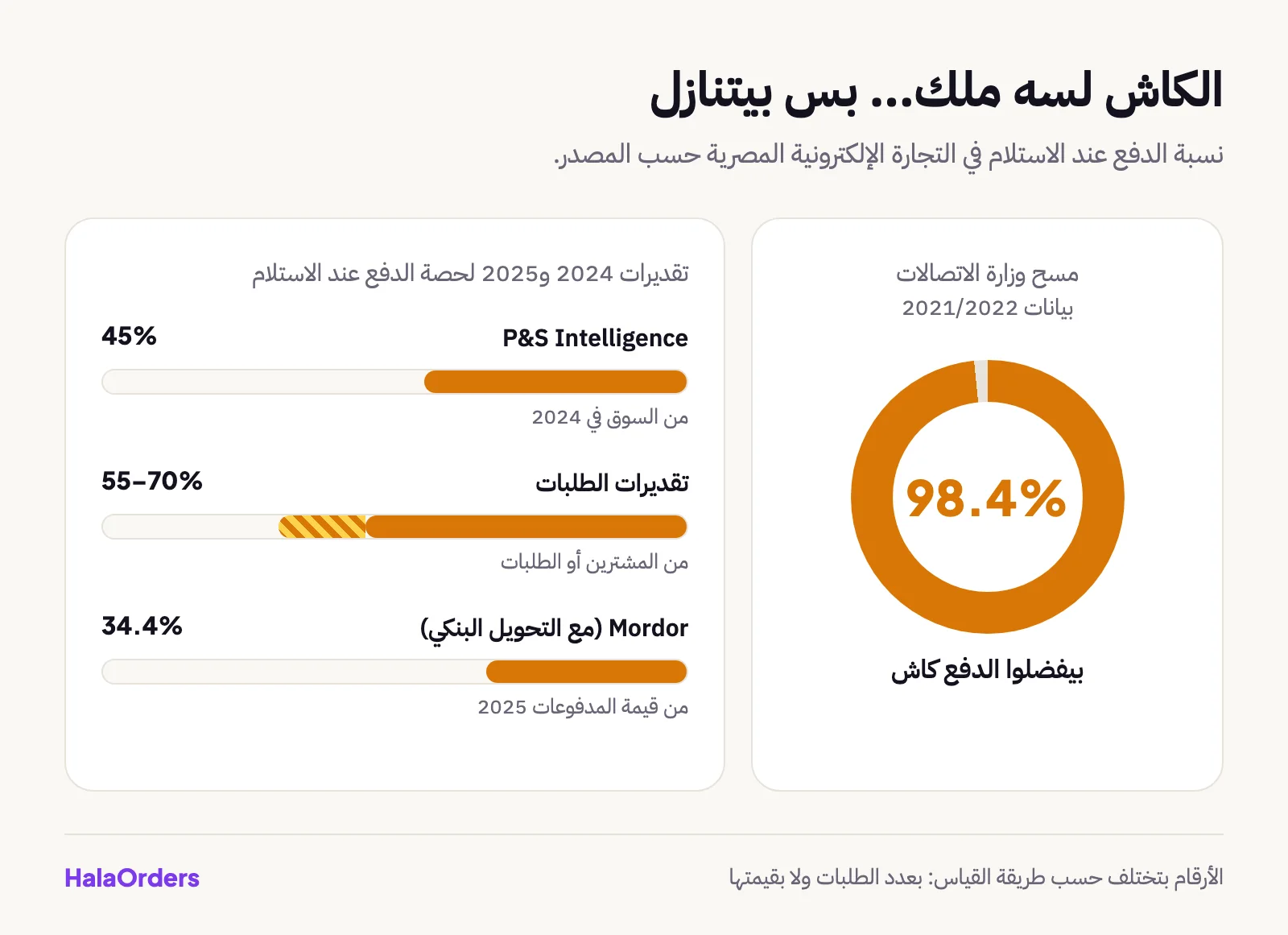
The practical takeaway: cash will be around for years, especially outside the big cities. But its share is falling fast. A smart store offers both and makes electronic payment the easiest option, without forcing anyone to use it. You can see all the available payment and shipping methods on the integrations page.
Where do people buy?
The same Ministry of Communications survey said that Facebook pages dominated 61.7% of the e-commerce activity it measured, followed by WhatsApp groups at 31.8%. So most selling in Egypt started, and still starts, on social media.
That isn't a flaw, it is reality. But there is a big difference between:
- A page that sells through messages: every order needs someone to reply, ask about the size, send the price, take the address and write it in a spreadsheet. And the customer who sent "How much?" at 2 a.m. and got no reply went and bought from someone else.
- A page that sends people to a store or a landing page: the customer sees the price, the sizes and the shipping fee for their governorate, and orders on their own, and the order reaches you written down and recorded.
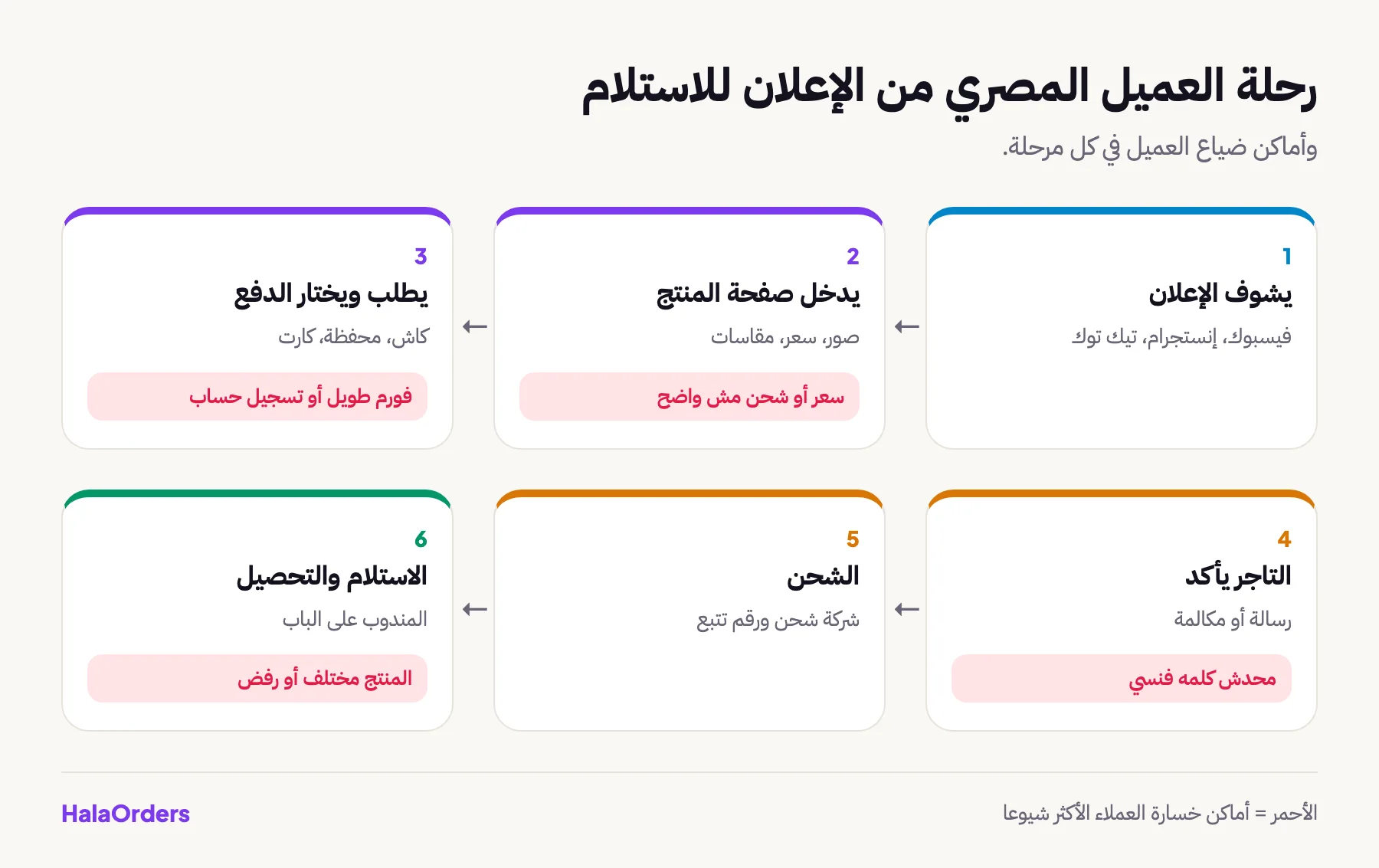
This journey has 4 places where customers are usually lost: before ordering (the price or shipping isn't clear), while ordering (the form is long or asks them to create an account), after ordering (nobody confirmed with them, so they forgot) and at the door (the product is different, or they don't have the money on them). Each of these points has a fix, and we cover them in upcoming articles.
6 trends that will matter to you in 2026
1. Social commerce has become paid advertising
Selling on social media is no longer free posts. Organic reach for pages is very low, and real sales come from Facebook, Instagram and TikTok ads. That means every visit has a price, and the page the customer lands on has to turn as many visitors as possible into orders. This is where a landing page makes a difference compared with a normal product page in a full store.
2. Measurement is now mandatory
Without the Meta and TikTok pixels and linking real orders to the ad, you are spending blind. Ad algorithms learn from orders, so the more accurate your data, the more the ad reaches people like your customers.
3. Fast shipping is an expectation, not a perk
Customers are used to delivery in two or three days. Every day of delay raises the chance they refuse the delivery or cancel. Connecting your store to a shipping company so you create the shipment from the dashboard, instead of copying the details by hand, saves time and mistakes.
4. Instant payments and wallets
As we saw in the numbers, InstaPay and Vodafone Cash have become part of people's lives, and a store should accept them in an organized way: the customer transfers and uploads a photo of the receipt, and the merchant reviews and confirms, instead of screenshots lost in WhatsApp.
5. Google Shopping and search
Not every customer comes from social media. Some search for the product by name on Google. If your products appear in Google Shopping and your pages are fast and well written, you get visits without paying for each one.
6. Data instead of gut feeling
A merchant who knows their conversion rate, their refusal rate in each governorate and their best-selling product decides faster and better than one who works by feel. That isn't a luxury for big companies, these numbers are in any decent dashboard.
From numbers to decisions: a quick table
| What the market says | The practical decision for your store |
|---|---|
| 98 million internet users, mostly on mobile | Design and test your store on mobile first, not on a laptop |
| 60 million active wallets and 16 million InstaPay users | Turn on wallet and InstaPay payments next to cash |
| Cash on delivery is still 45% to 70% | Keep it, but use deposits and order confirmation |
| Facebook and WhatsApp drive most sales | Send ad traffic to a clear order page instead of messages |
| The market grows 12% to 15% a year | Measure your own growth against that number every quarter |
HalaOrders was built for exactly this market
At HalaOrders we work with Egyptian merchants, so the platform was built on the same numbers above:
- Cash on delivery with a deposit: you can ask for the deposit as the delivery fee, a percentage of the price or a fixed amount, on the products you choose.
- InstaPay, Vodafone Cash and bank transfer: the customer transfers and uploads a photo of the receipt on the order itself, so you don't have to search the chat.
- The Paymob gateway: for online card and wallet payments.
- Landing pages with A/B testing: a quick order page for Facebook and TikTok ads, where you can try several designs and let the system pick the one that sells best.
- Sky Express: create and track the shipment from the dashboard, with different delivery fees for each governorate and city.
- Meta Pixel, TikTok Pixel and Google Merchant Center: to measure your ads and appear in Google Shopping.
- Telegram alerts: every new order reaches your phone, along with a daily report.
If you are just starting, begin with the guide to opening an online store in Egypt from scratch, or see the plans and prices.
The bottom line
The Egyptian market is big and growing, and the customer is on a phone with a wallet. What sets one merchant apart from another in 2026 isn't being online, that is now the baseline. What sets them apart is making ordering easy, offering convenient payment methods, shipping fast and measuring everything. Start with your own numbers: how many visitors, how many orders, how many delivered. From there every decision becomes clearer.
Frequently asked questions
How big is the e-commerce market in Egypt?
Estimates vary with the method: from about 2.3 billion dollars in 2025 (ECDB) to 11.5 billion dollars in 2026 (Mordor Intelligence). The gap comes from some reports counting services such as travel and food delivery, while most don't count sales made in Facebook and WhatsApp messages. What they agree on is that the market grows by 12% to 15% a year.
How many Egyptians use the internet?
About 98.2 million users at the end of 2025, or 82.7% of the population, according to DataReportal's Digital 2026 report.
How much is cash on delivery still used in Egypt?
Recent estimates put it between 45% and 70% of e-commerce depending on the measurement method, down from 98.4% of online shoppers preferring cash in the Ministry of Communications survey of 2021/2022 data.
How many mobile wallets are there in Egypt?
The National Telecom Regulatory Authority announced 46.3 million active wallets in Q2 2025, and the Egyptian Center for Economic Studies estimated about 60 million at the end of 2025.
Sources
- DataReportal: Digital 2026 Egypt
- National Telecom Regulatory Authority: mobile wallet indicators for Q2 2025
- Egyptian Center for Economic Studies: Economic Lens issue 17
- Daily News Egypt: financial inclusion and InstaPay numbers in June 2025
- Ahram Online: Facebook pages and WhatsApp groups in e-commerce (Ministry of Communications)
- Mordor Intelligence: Egypt E-commerce Market
- ECDB: E-commerce in Egypt
- P&S Intelligence: Egypt E-commerce Market