You once went to Amazon looking for headphones, and below them you saw "frequently bought together: a case and a charger". You meant to buy just the headphones, and you left with three things. That isn't a coincidence; it is a recommendation system at work.
The question a merchant with a small store asks is: "I'm not Amazon, can I do this?". The short answer is that there is a difference between smart recommendation tools (Nosto, Rebuy and Algolia), most of which are designed for large stores, and manual recommendations that any small store can set up today without paying a pound. This article explains both, and runs the numbers so you know whether a tool is worth it.
In short: smart recommendations in stores are a system that suggests suitable products to each customer based on their behavior, and their goal is to raise the average order value. If your store is still small, start with product bundles, quantity offers and promo codes with a minimum order, and leave smart tools until you have thousands of visits and orders a month.
What are smart recommendations in online stores?
Smart recommendations (product recommendations) are a set of products shown to the customer automatically based on what they viewed or bought, or what similar people bought. They appear on the product page ("frequently bought together"), in the cart ("complete your order with..."), after the order and in email.
The best-known types:
- Frequently bought together: products often sold together (a case with a phone).
- Related products: products similar to the one being viewed.
- Trending: the best sellers right now.
- Personalized: based on the customer's own history.
They serve two goals: upsell (selling a more expensive version of the same product) and cross-sell (selling something that complements it).
Does personalization really make a difference to sales?
According to a McKinsey study published in November 2021, 71% of customers expect companies to offer them personalized experiences, and 76% get frustrated when that doesn't happen. The same study says personalization typically lifts revenue by 10 to 15%, and that fast-growing companies get 40% more of their revenue from personalization than others.
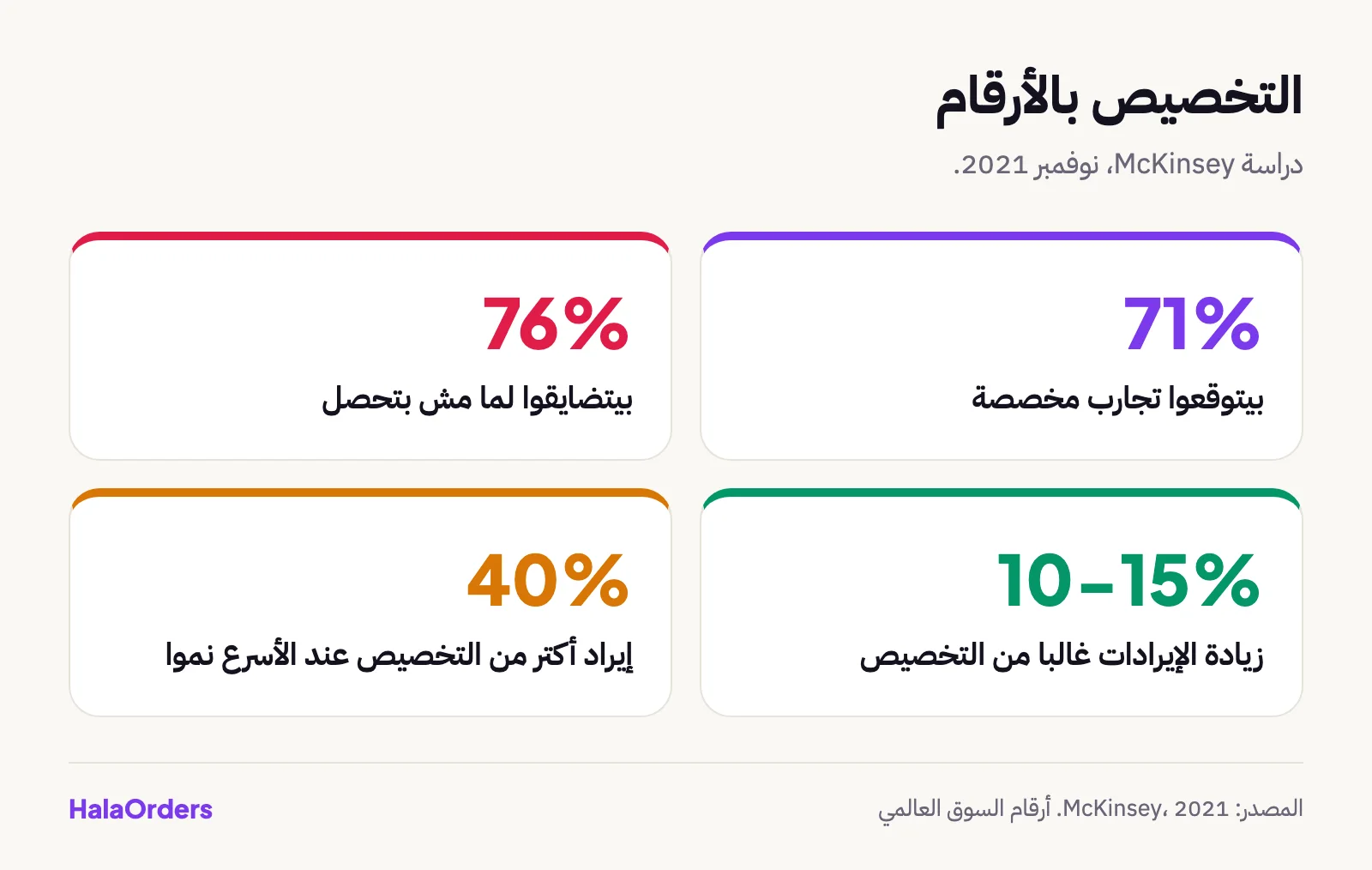
These numbers are about the global market and large stores, so treat them as a direction, not a promise. Your small store won't necessarily see the same number, but the principle is clear: customers like it when you help them find what they need.
How do recommendations raise the average order value? (a simple calculation)
Average order value (AOV) = total sales ÷ number of orders. It is the cheapest way to grow revenue, because the customer is already there and you have already paid the cost of bringing them.
An example with hypothetical numbers for a clothing store: 200 orders a month, with an average order of 450 EGP.
| Scenario | Average order | Orders | Total sales |
|---|---|---|---|
| Before any recommendations | 450 EGP | 200 | 90,000 EGP |
| A "two pieces" bundle with a small discount | 520 EGP | 200 | 104,000 EGP |
| A bundle + a minimum order for a shipping discount | 560 EGP | 200 | 112,000 EGP |
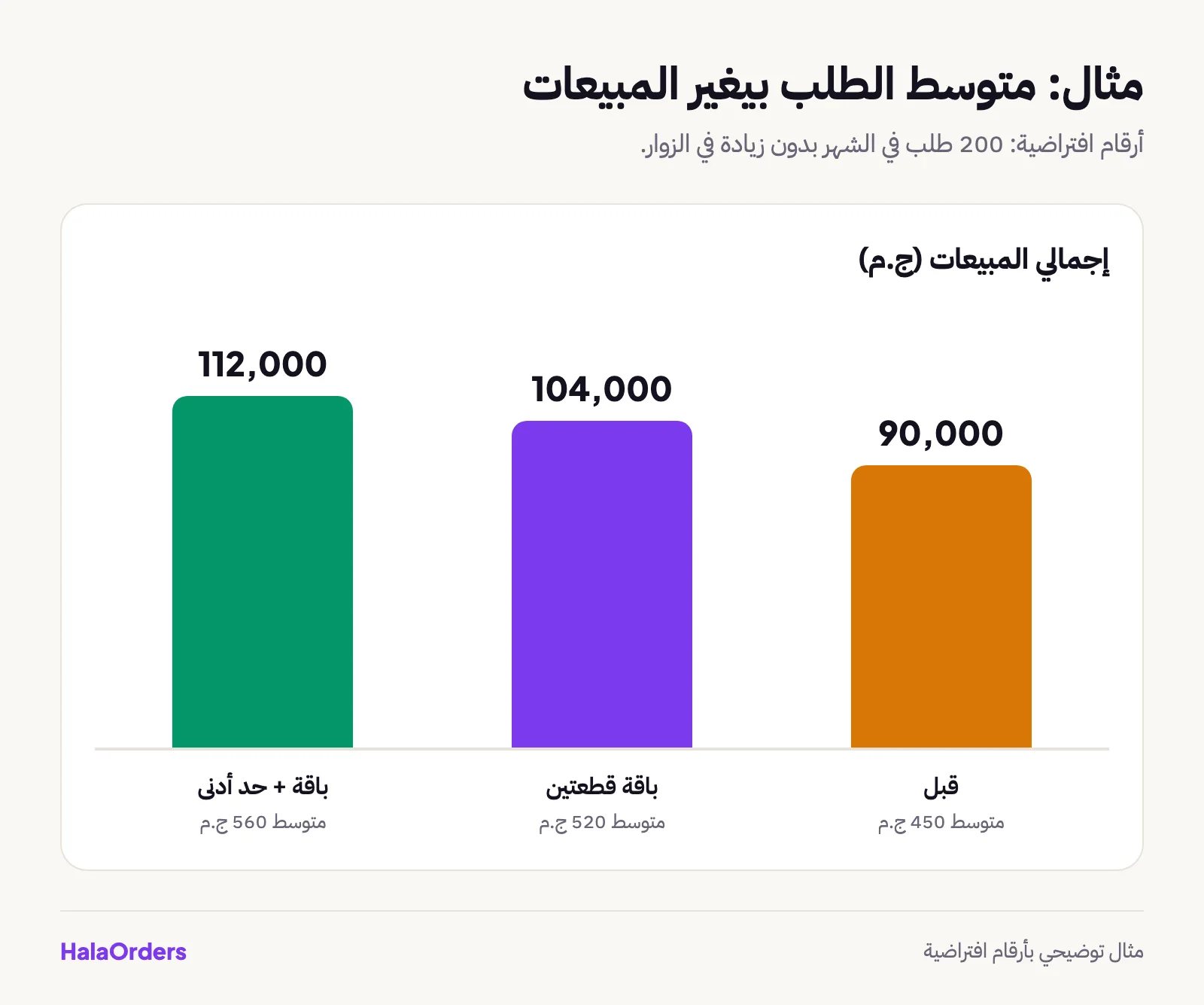
Notice that the number of orders stays the same, and all the increase comes from the customer adding something else. Calculate the profit margin after the discount in the profit calculator before launching any offer, and if you want to understand the math better, read conversion rate.
What are the best-known smart recommendation tools?
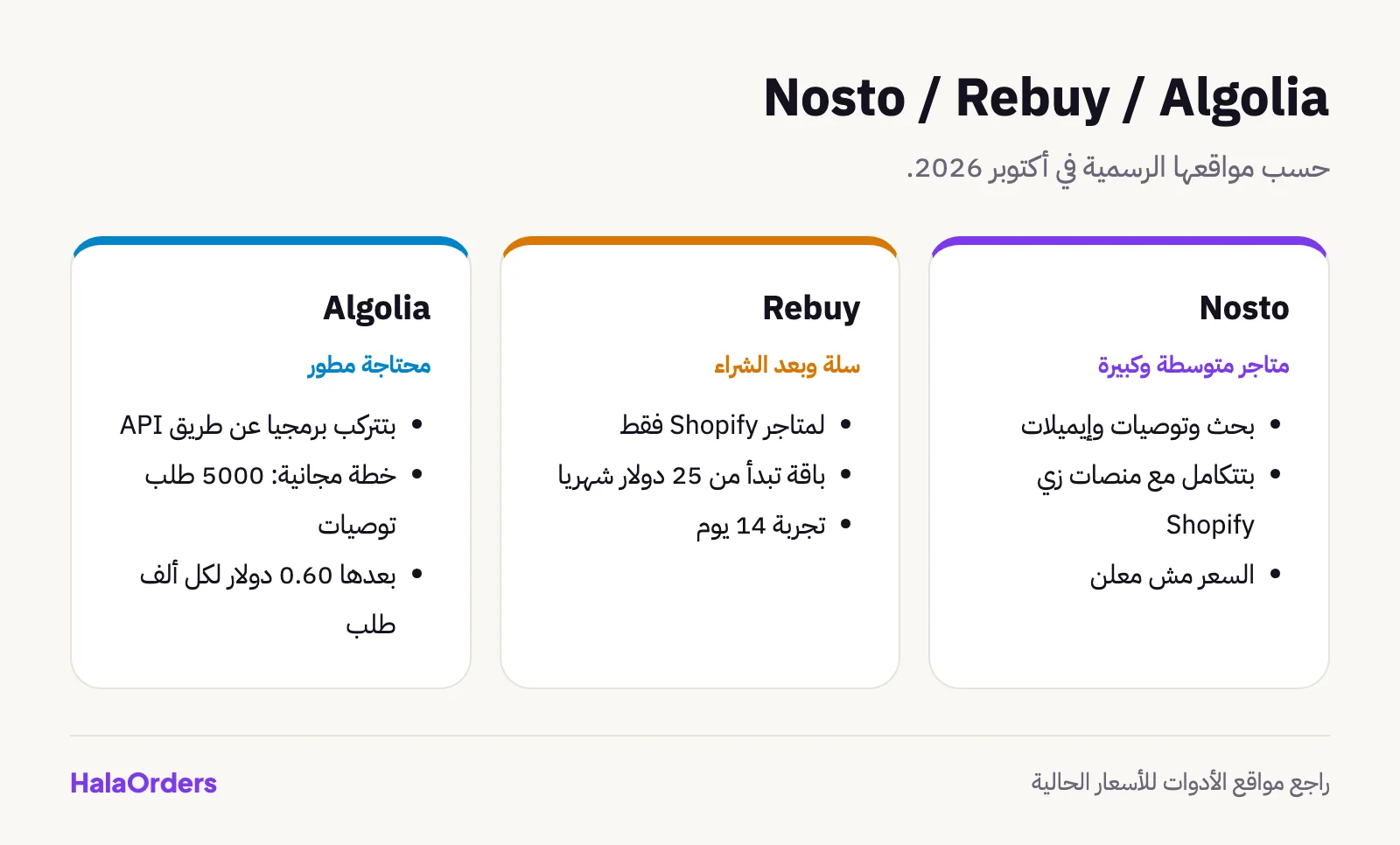
They all do the same basic thing, but differ in scale, cost and ease of use. This information comes from their official websites in October 2026.
Nosto
A platform for personalizing the shopping experience: search, recommendations, category ordering, post-purchase offers and personalized emails. It integrates with Shopify, Salesforce Commerce Cloud, Shopware, Adobe Commerce and BigCommerce. Its prices aren't published; the website says they depend on traffic and features and asks you to contact sales. So it is probably for medium and large stores.
Rebuy
A tool built for Shopify stores: recommendations in the cart and after purchase, search and testing. Pricing is by monthly orders, with a single bundle starting at 25 dollars a month, and a 14-day free trial for subscription bundles. But it doesn't work with a store on a platform other than Shopify.
Algolia
A search and recommendations engine installed through an API, so it needs a developer. It has a free plan with 10 thousand search requests and 5 thousand recommendation requests a month, and then paid plans by usage (extra recommendations at 0.60 dollars per thousand requests on the Grow plan). It suits you if you have a developer and are looking for fast search with smart features.
Important to know: HalaOrders has no built-in smart recommendations, and tools like Nosto and Rebuy are designed for specific platforms. So if your store is on HalaOrders, the manual alternatives below are what you will actually use.
What are the manual alternatives for a small store?
Manual recommendations mean you choose yourself what sells with what. A store with 50 products doesn't need AI to know that a case sells with a phone.
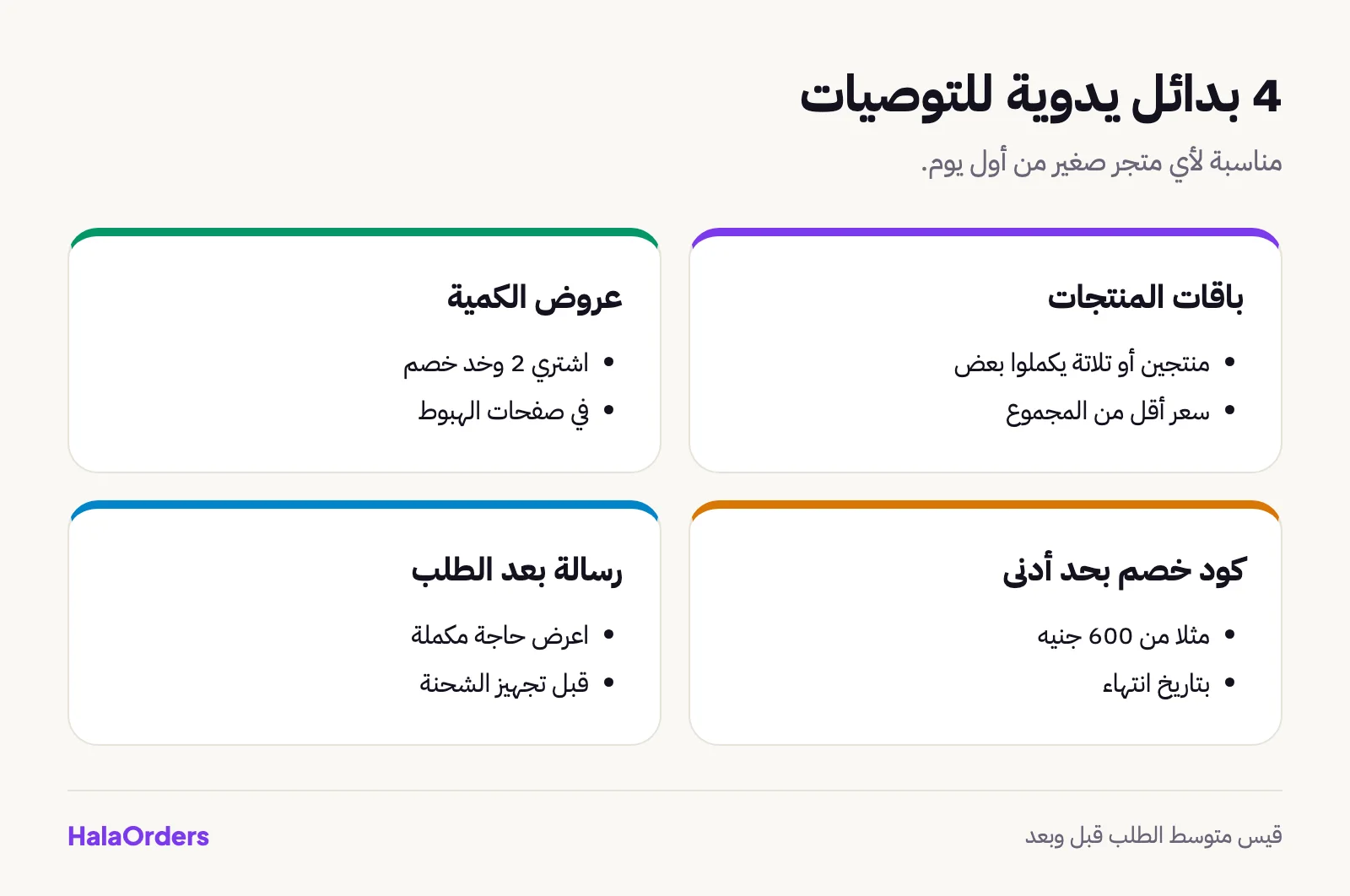
- Product bundles: group two or three complementary products at a price below their total. For example: cream + serum + cleanser for 780 EGP instead of 870.
- Quantity offers: "buy 2 and get 10% off". On HalaOrders landing pages you can add quantity offers and a countdown.
- A promo code with a minimum: a promo code with a minimum order (600 EGP, for example) encourages the customer to add a piece.
- Manual linking: add links to complementary products in the product description ("complete the set").
- A message after the order: call or message the customer to offer something complementary before the shipment is prepared.
If you want to understand more about turning visitors into repeat customers, read repeat customers and retention.
When should I use a smart tool instead of the manual approach?
Choose by size:
- Under 100 orders a month: fully manual. The tool will cost you more than you earn from it.
- 100 to 500 orders: manual, while tracking the data to see which products actually sell together.
- Thousands of orders and a large catalog: this is when smart tools make a difference, because it is impossible to manage a thousand products by hand.
Mistakes merchants make
- Random recommendations unrelated to the product.
- Products out of stock showing in the recommendation.
- A big discount on the bundle that eats the margin.
- A cluttered page: 8 recommended products distract the customer from buying.
And consider privacy too: personalization tools collect customer behavior data, so you need a clear privacy policy.
HalaOrders helps with the manual part
HalaOrders is an Egyptian platform for building online stores and landing pages. What you can use to raise the average order:
- Landing pages with quantity offers, a countdown and the order form on the page.
- Promo codes: a percentage or a fixed amount, a minimum order, start and end dates, a usage limit, and optionally a specific product.
- Products with their variants and stock alerts, so you don't show a product that has run out.
- A/B testing of up to 4 versions of the page, picking the best automatically at 95% confidence.
- Meta Pixel and Google Analytics to measure the results of offers.
See the plans if you are still choosing.
How do you know a recommendation worked?
Before you start, record two numbers: the average order value and the average number of items per order. After launching the bundle or offer, wait at least two weeks and compare. If both numbers went up while the refusal and return rates stayed the same, the offer is working. If the average went up but returns increased, you are selling customers something they don't need.
Also compare with and without the offer at the same time if possible, rather than month against month, because seasons change the numbers. On landing pages you can do this easily with two versions of the page.
The bottom line
The goal of recommendations is to raise the average order value, not the number of visitors. According to McKinsey 2021, 71% of customers expect personalization. But your small store doesn't need Nosto or Rebuy from day one. Start with a product bundle, a quantity offer and a promo code with a minimum, measure the average order before and after, and once you grow, consider a tool.
Frequently asked questions
What are smart recommendations in an online store?
A system that automatically shows each customer suggested products based on what they viewed or bought, like "frequently bought together". Its goal is to raise the average order value. According to McKinsey 2021, 71% of customers expect personalized experiences, and 76% get frustrated when they don't happen.
How much do recommendation tools like Nosto, Rebuy and Algolia cost?
Nosto doesn't publish its prices and negotiates based on traffic. Rebuy starts at 25 dollars a month for one bundle and is built for Shopify. Algolia has a free plan with 5 thousand recommendation requests a month, then 0.60 dollars per extra thousand on the Grow plan (according to their websites in October 2026).
How do I raise the average order value without a tool?
Use product bundles priced below their total, quantity offers like "buy 2 and get 10% off", and a promo code with a minimum order. In our hypothetical example, raising the average from 450 to 520 EGP with 200 orders increases sales from 90 thousand to 104 thousand EGP.
When do I need a smart recommendation tool?
When you have thousands of visits and orders a month and a large catalog that is hard to arrange by hand. If you have fewer than 100 orders a month, the manual alternatives are cheaper and enough.
Do recommendations affect store speed?
They can. Recommendation tools add a script or API requests to the page, which can slow it down if not set up well. Measure the speed before and after installing using Core Web Vitals.