You opened ChatGPT and typed: "What's the best bedspread store in Egypt?". The reply gave you five names, and your store wasn't among them. You tried the same question on Google, and above the search results was an AI summary answering the customer before they clicked any link. The customer made their decision without visiting a website.
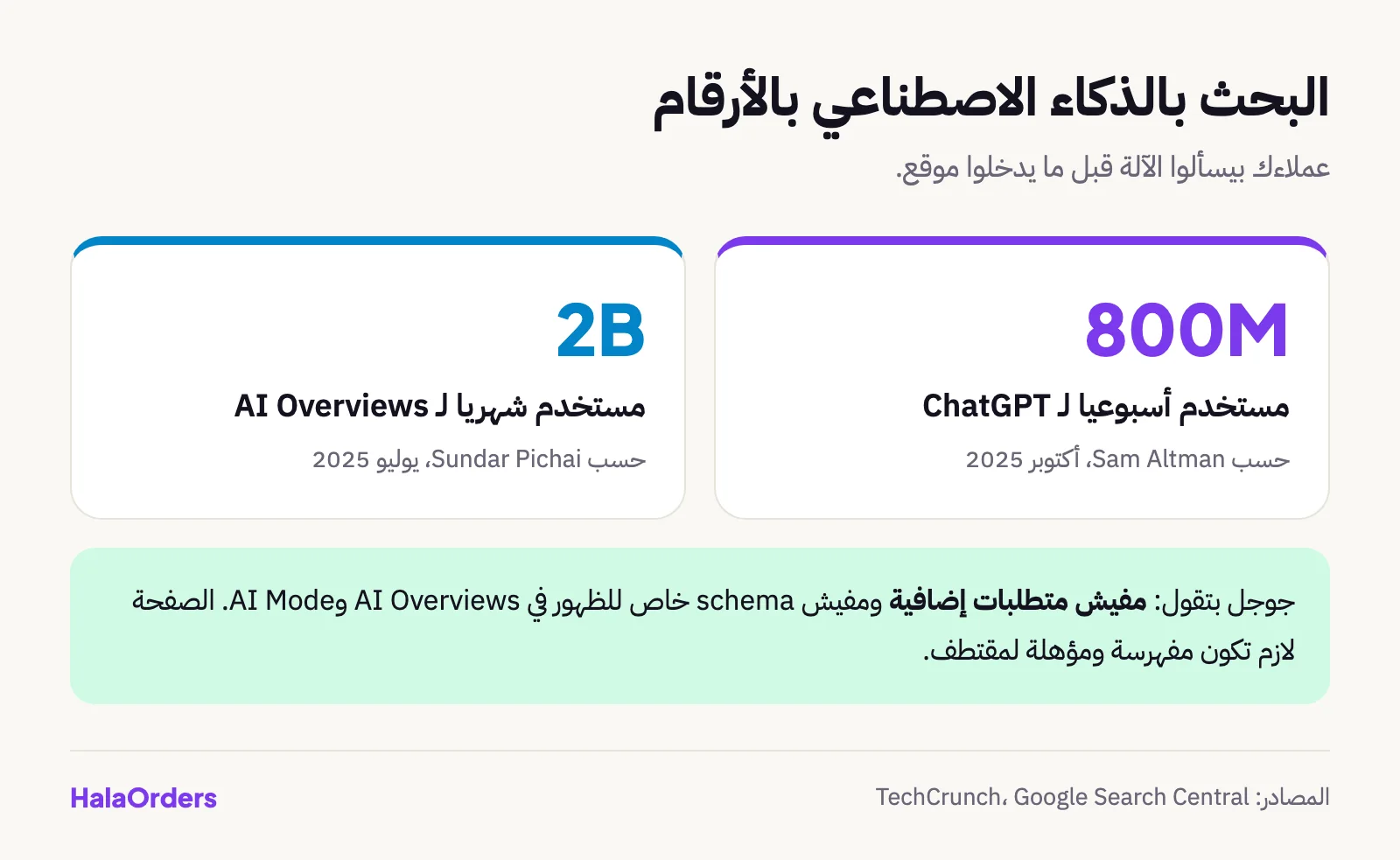
That is now part of the game. According to Sam Altman in October 2025, ChatGPT reached 800 million weekly users, and according to Sundar Pichai in July 2025, Google's AI Overviews reached 2 billion monthly users. In this article we explain how to get your store into ChatGPT and Google AI: what works, what is hype, and how to measure it.
In short: appearing in ChatGPT and Google AI depends on the same basics that make good SEO: pages that get indexed, content that answers the question directly, correct product data, and your brand name being mentioned elsewhere on the internet. Google itself says there are no additional requirements and no special schema for appearing in AI Overviews or AI Mode. Allow the search crawlers (OAI-SearchBot and PerplexityBot) in your robots.txt file, build clear answer pages, and check the results monthly.
What are GEO and AEO?
GEO (Generative Engine Optimization) is optimizing your site's content so generative AI engines such as ChatGPT, Perplexity and Gemini quote it or mention your brand in their answers. AEO (Answer Engine Optimization) is optimizing pages to be taken as a direct answer in summaries and featured snippets. The two terms overlap, and the practical meaning is the same: make your page the easiest source for the machine to quote.
Is appearing in AI different from SEO?
Not much. Google's "AI features and your website" page says a page must be indexed and eligible to appear with a snippet in Google to be shown as a supporting link in AI Overviews or AI Mode. It says literally that "there are no additional requirements", that there is no special schema.org you need to add, and that any structured data you add must match the visible text on the page. Traffic from these features is counted inside the Performance (Web) report in Search Console.
So if your store isn't indexed, is slow or has thin pages, no "GEO trick" will help. Start with store speed and Core Web Vitals.
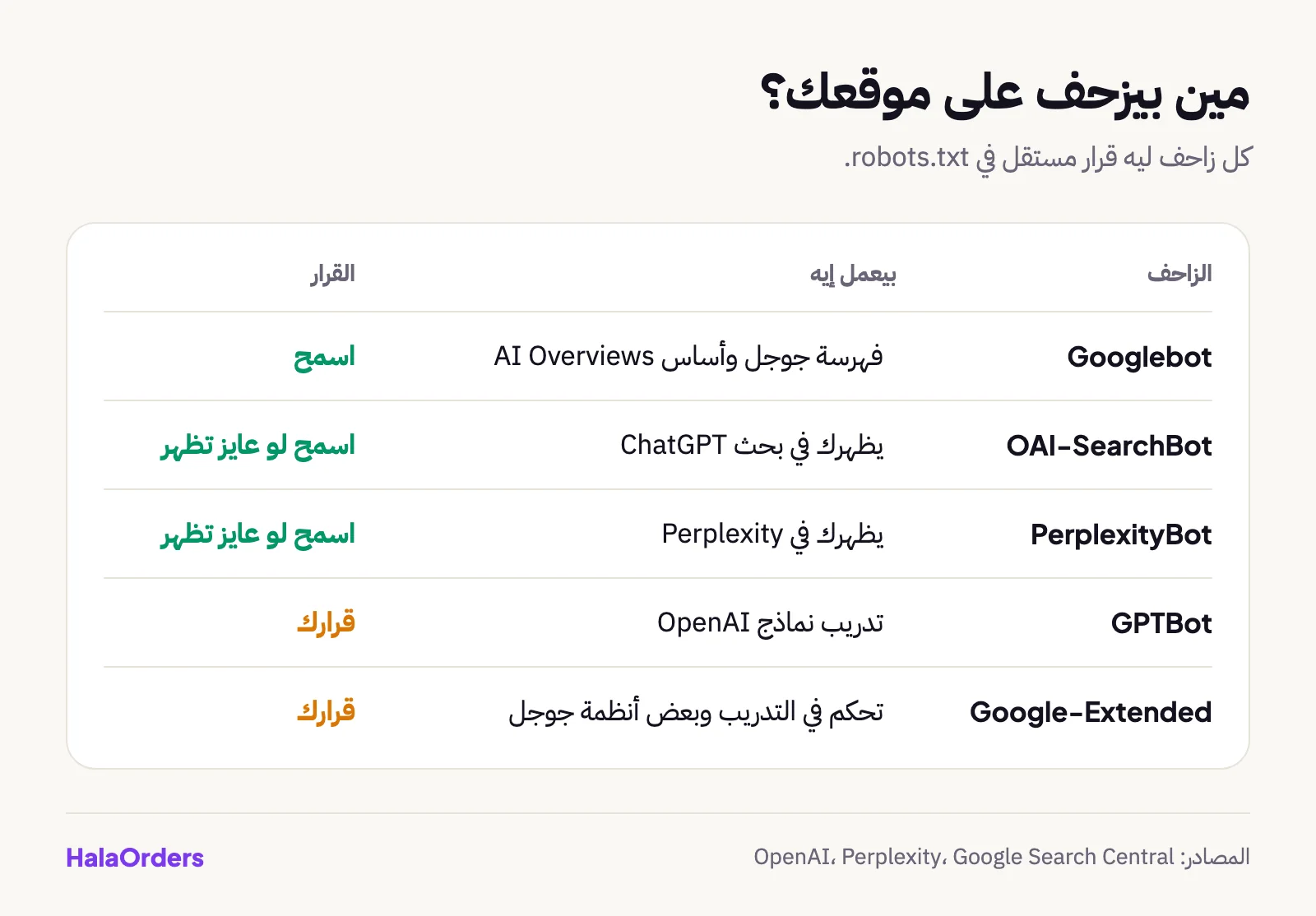
Who crawls my site, and whom can I block?
| Crawler | What it does | Allow or block? |
|---|---|---|
| Googlebot | Google indexing, and the basis for AI Overviews and AI Mode | Allow |
| OAI-SearchBot (OpenAI) | Shows your site in ChatGPT search results | Allow if you want to appear |
| PerplexityBot | Shows your site in Perplexity results | Allow if you want to appear |
| GPTBot (OpenAI) | Training OpenAI's models, separate from search | Your choice |
| Google-Extended | Controls use of content for training and some other Google systems | Your choice |
According to OpenAI's documentation, if you block OAI-SearchBot you won't appear in ChatGPT search answers (only a navigational link may appear), and it recommends allowing it in robots.txt; the settings are independent of GPTBot. Perplexity says the same about PerplexityBot. Changes take about 24 hours.
User-agent: OAI-SearchBot
Allow: /

User-agent: PerplexityBot
Allow: /
How do I write store pages that AI will quote?
These systems look for a clear answer that can be quoted. Apply the following to product pages, categories and the blog:
- Start the page with a direct answer in the first 2 or 3 sentences: "100% cotton bedspreads suit...".
- Write definitions as full sentences: "A double bedspread is...".
- Use headings phrased as questions the way people type them: "How do I wash a cotton bedspread?".
- Add a comparison table (materials, sizes, prices), because tables are easy to extract.
- Write numbers and dates clearly: "Delivery takes 2 to 4 days to Cairo and Giza" is better than "fast delivery".
- Add an FAQ section with 40 to 80 word answers, each one understandable on its own.
- Make clear policy pages (exchanges, shipping, payment), because they answer customers' questions and build trust.
An example (hypothetical): a bedspread page that starts with "The most beautiful bedspread for your room, discover our special collection" has nothing to quote. The same page starting with "A 100% cotton bedspread, 220 × 240 cm, at 850 EGP, machine washable at 30 degrees, delivered to every governorate within 2 to 5 days" has 5 facts that can be taken as an answer. The difference is in the details, not the literary style.
Since August 2023 Google has limited FAQ rich results to well-known government and health websites, so don't expect FAQ stars in your results. But clear questions and answers are still useful to the customer and to any system reading your page.
Product structured data
According to Google, Product structured data lets product details such as price, availability, rating and shipping and return policies appear more richly in search. If you sell, the pages where a customer can buy are called "merchant listings". What matters is that the markup matches what the customer sees on the page, and that you test it with Google's Rich Results Test. Connecting your products to Google Merchant Center also gives Google structured product data.
Does an llms.txt file make a difference?
llms.txt is a proposed file that summarizes your site for models. So far there is no evidence it has an effect. According to Google's John Mueller in June 2025: "FWIW no AI system currently uses llms.txt", and chatbots fetch your pages but don't fetch this file. You can add it if it is easy, but don't spend time on it before the basics above.
Why do brand mentions elsewhere matter?
These systems learn which brands are known in a field from what is written about them in many places. An Ahrefs study in December 2025 of 75 thousand brands found that the strongest correlation (Spearman) with appearing in AI answers was for brand mentions on the web (about 0.66 to 0.71 depending on the platform) and mentions in YouTube videos (about 0.74), while Domain Rating was much weaker (0.27 to 0.33). Ahrefs itself points out that this is correlation, not causation, and that the sample was of relatively large brands, which may not apply to small stores.
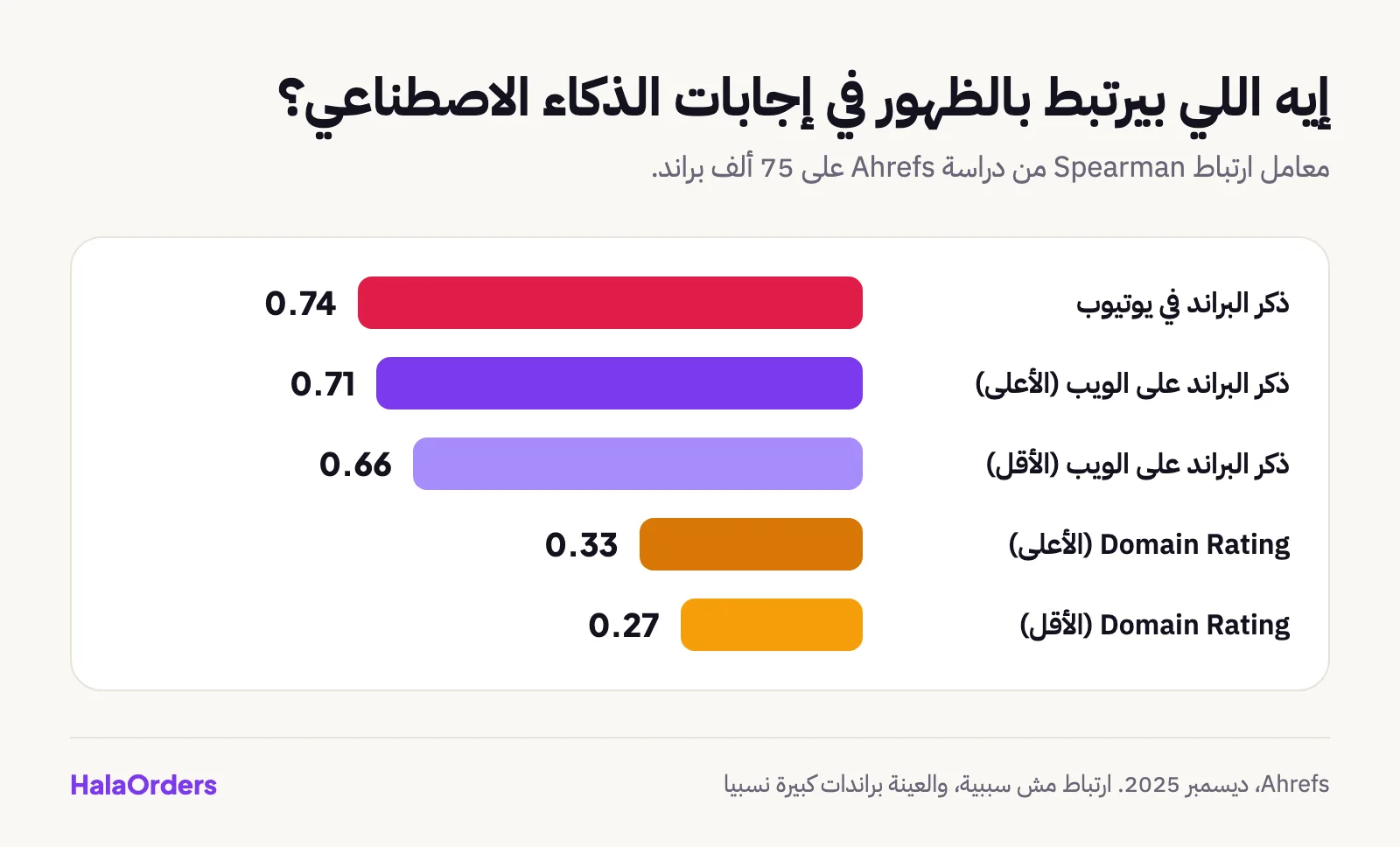
The practical lesson is simple: get your store's name mentioned. Make short videos about your products, let small influencers and bloggers try your product, write useful content in your field, and keep your brand details (the name, the domain, the social accounts) consistent everywhere. And if you organize your social content, see social media management tools.
How do I know whether my store appears?
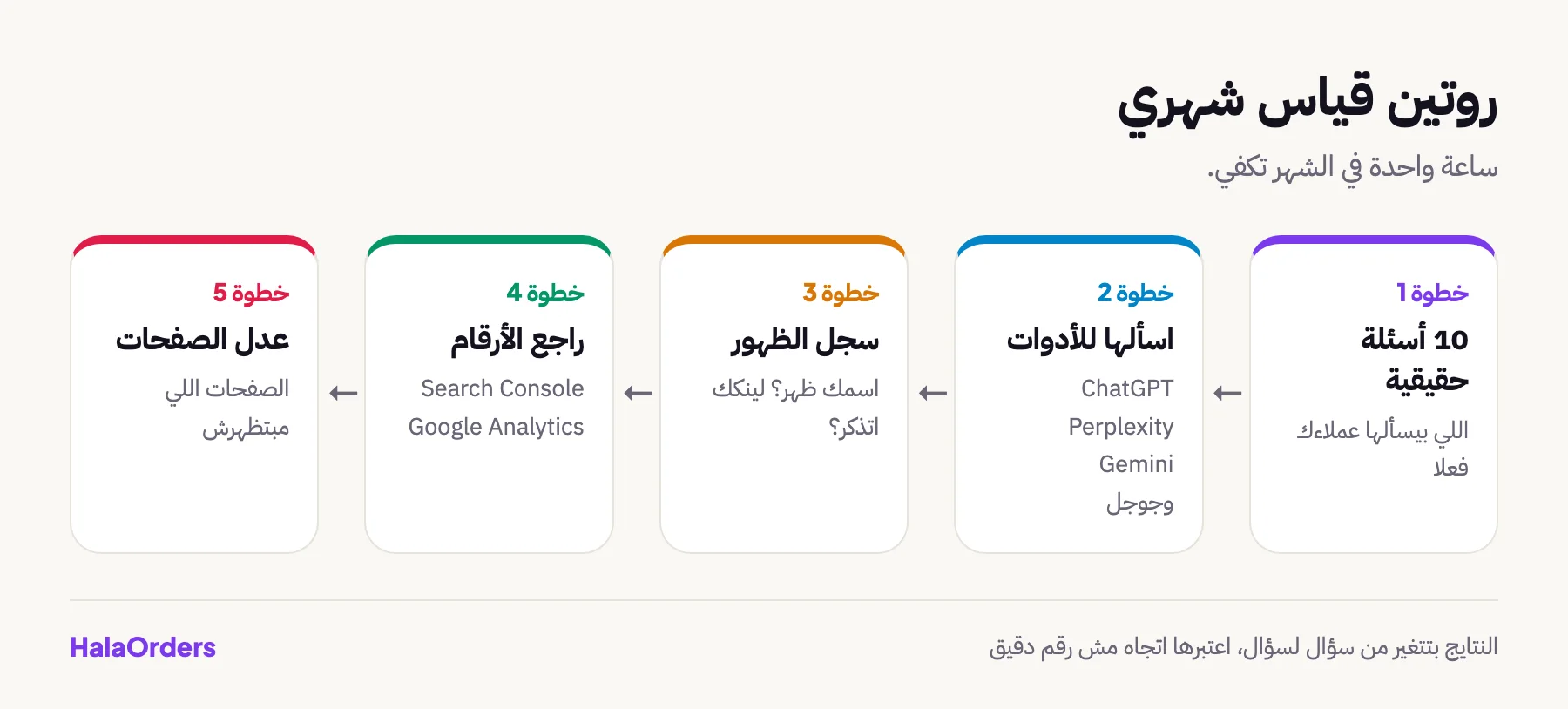
- Write 10 questions your customers actually ask ("best cotton bedspreads in Egypt?").
- Ask them in ChatGPT, Perplexity, Gemini and Google once a month, and record whether your name or a link appeared.
- Check Search Console: traffic from these features is counted in the Performance report for web search.
- Review traffic sources in Google Analytics and see whether a source from AI tools appears.
- Compare month to month and improve the pages that don't appear.
Results vary from question to question and from day to day, so treat them as a trend, not a precise number.
How does HalaOrders help you appear?
HalaOrders is an Egyptian platform for building online stores and landing pages. What serves the basics above:
- Clean URLs and a sitemap that help crawlers understand your store.
- A store with a mobile design and WebP images resized automatically, so it opens faster.
- A custom domain with free SSL, so your brand stays consistent.
- Google Merchant Center for your products through a product feed, and a Google Analytics connection from the dashboard.
- A blog inside the store where you publish useful content and FAQs.
- Dedicated solution pages for fashion and home decor stores.
HalaOrders doesn't promise you'll appear in ChatGPT, because no platform can guarantee that. It gets the technical basics ready so you can focus on content. See the plans.
The bottom line
AI hasn't changed the rules as much as it has changed who benefits from them. Indexed, fast pages, direct answers, correct product data and a brand name that gets mentioned. Allow the crawlers, build one answer page a week, and measure monthly.
Frequently asked questions
How do I get my store to appear in ChatGPT?
Allow the OAI-SearchBot crawler in robots.txt, keep your pages indexed and fast, and write content that answers customers' questions directly. According to OpenAI, if you block OAI-SearchBot you won't appear in ChatGPT search answers. There is no guarantee of appearing.
Do I need to add a special schema to appear in AI Overviews?
No. According to Google's "AI features and your website" page, there are no additional requirements and no special schema.org. The page must be indexed and eligible to appear with a snippet, and its structured data must match the visible text.
Does an llms.txt file help with appearing in AI?
So far there is no evidence. Google's John Mueller said in June 2025 that no AI system currently uses llms.txt. Focus first on indexing, clear content and product data.
What is the difference between GPTBot and OAI-SearchBot?
GPTBot is OpenAI's crawler for training models, and OAI-SearchBot is the one that shows your site in ChatGPT search results. The two settings are independent in robots.txt, so you can allow search and block training, or the other way round.
How do I measure my store's visibility in AI answers?
Write 10 real questions from your customers, ask them monthly in ChatGPT, Perplexity, Gemini and Google, and record whether your name or link appears. And check the Performance report in Search Console, because traffic from AI features is counted there.
Sources
- Google Search Central: AI features and your website
- Google Search Central: Product structured data
- Google Search Central: Changes to HowTo and FAQ rich results (August 2023)
- OpenAI: Overview of OpenAI crawlers
- Perplexity: Perplexity crawlers
- TechCrunch: Sam Altman says ChatGPT has hit 800M weekly active users
- TechCrunch: Google's AI Overviews have 2B monthly users
- Ahrefs: Top Brand Visibility Factors in ChatGPT, AI Mode, and AI Overviews
- Search Engine Roundtable: Google, no AI system currently uses llms.txt