Most merchants spend 90% of their effort and money on one thing: a new customer. A new ad, a new audience, a new offer. Meanwhile there are hundreds of customers who bought from them before, liked the product, whose phone numbers and addresses they have, and nobody has contacted them again.
A customer who has bought from you once is the easiest customer you can sell to. They know you, they have tried your quality and they actually received an order, so they are not a fake order. In a cash-on-delivery market especially, that is worth a lot.
In this article we calculate why a returning customer makes a difference to profit, how to measure it in your store, and a practical post-purchase journey that brings the customer back.
In short: a returning customer brings much more profit than a new one, because they don't need an ad and are less likely to refuse delivery. Calculate customer lifetime value (CLV), and build a post-purchase journey: confirmation, a shipping update, a thank-you card and a promo code, a check-in after 3 days, and a complementary offer after 30 days.
Why does a returning customer matter more than a new one?
Frederick Reichheld of Bain & Company, the creator of the NPS score, published a famous study saying that increasing customer retention by just 5% can raise profits by 25% to 95%, depending on the type of business. Other widely quoted estimates (including ones cited by Forrester) say that acquiring a new customer can cost 5 to 25 times as much as keeping an existing one.
These are global numbers and they vary by industry, but the logic behind them is very simple, and you can see it in your own store's numbers:
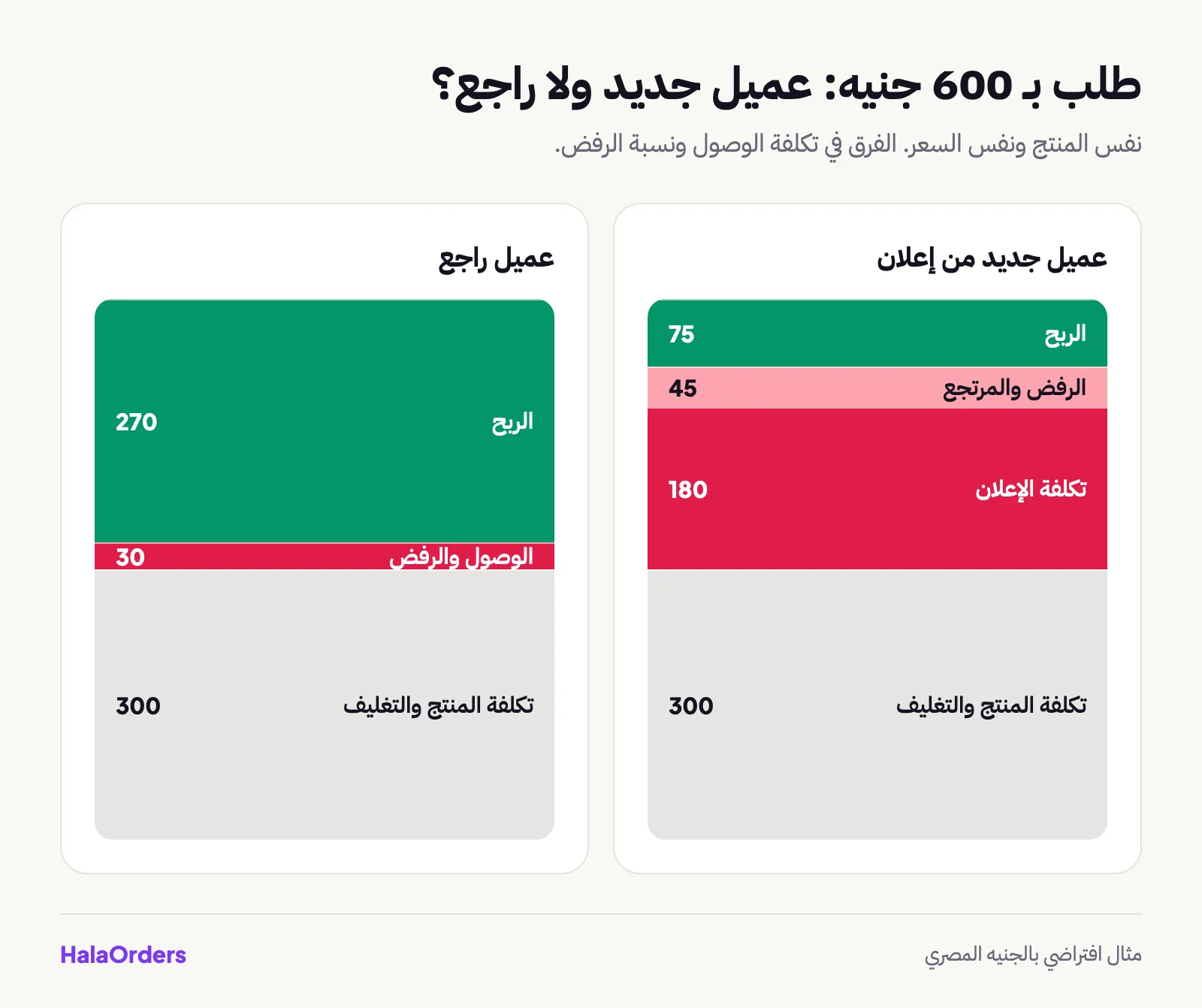
This example is hypothetical but realistic: a 600 EGP product that costs 300.
| New customer from an ad | Returning customer | |
|---|---|---|
| Selling price | 600 EGP | 600 EGP |
| Product and packaging cost | 300 EGP | 300 EGP |
| Ad cost per order | 180 EGP | 15 EGP (a message or promo code) |
| Refusal and return loss (average) | 45 EGP | 15 EGP |
| Profit | 75 EGP | 270 EGP |
The same product, the same price, and the profit is more than three and a half times higher. That is why stores that last for years get a large share of their sales from existing customers.
4 numbers you need to know about your customers
1. The share of customers who buy again
Repeat purchase rate = customers who ordered twice or more ÷ total customers
If you have 800 customers and 120 of them ordered more than once, the rate is 15%.
2. Average orders per customer
Average orders = total orders ÷ number of customers
3. Average order value
Average order value = total sales ÷ number of orders
4. Customer lifetime value (CLV)
This is the most important of them, because it tells you how much a customer is worth spending on:
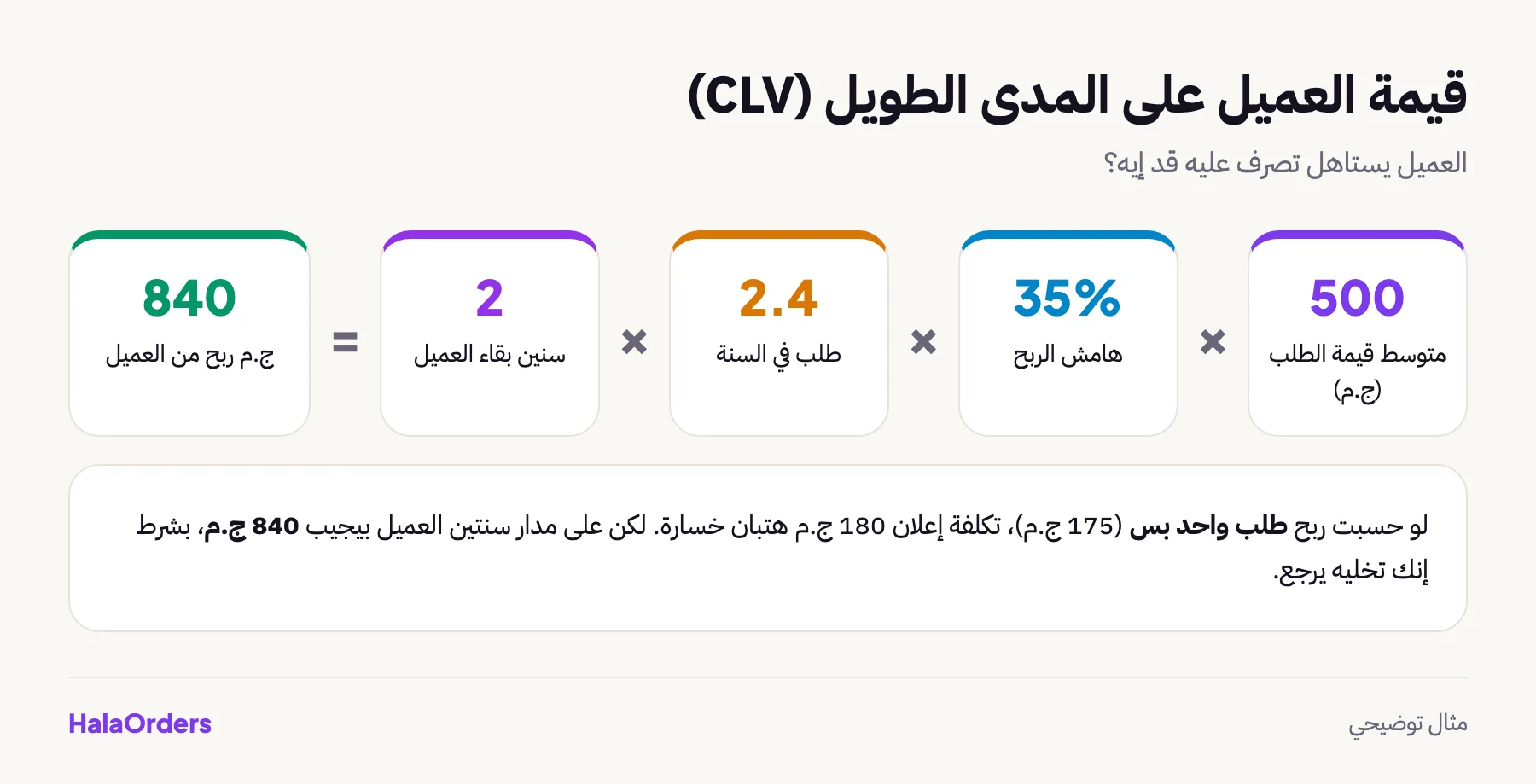
Customer value = average order value × profit margin × orders per year × years the customer stays
In the example: 500 × 35% × 2.4 × 2 = 840 EGP of profit from a single customer.
Why does this matter? Because if you assume a customer brings the profit of one order only (175 EGP), you will see 180 EGP of ad cost as too much and stop the campaign. But if you know the customer brings 840 EGP over two years, that campaign can be one of your best investments. Provided you actually do something to bring them back.
What retention looks like in stores
If you look at the customers who bought for the first time in a given month, and follow how many of them came back to buy in the following months, you will find a shape like this:
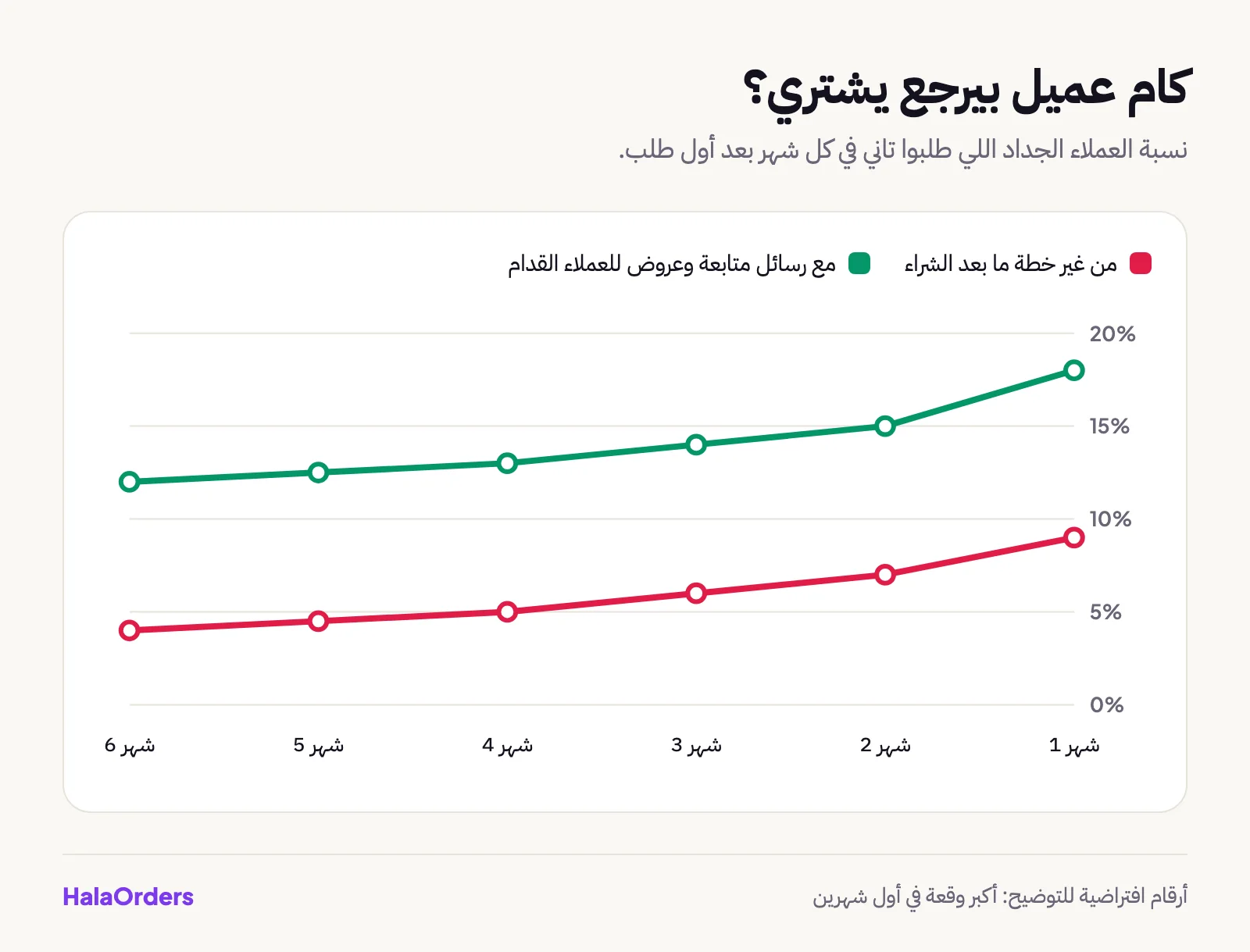
The numbers here are illustrative, and the key idea is: the biggest drop happens in the first month or two. If the customer doesn't hear from you after delivery, they forget you. If they hear from you at the right time with the right message, the chance they return goes up a lot.
The post-purchase journey: 30 days that make a difference
This is the most important part of the article. The relationship with the customer doesn't end at delivery, it begins there:
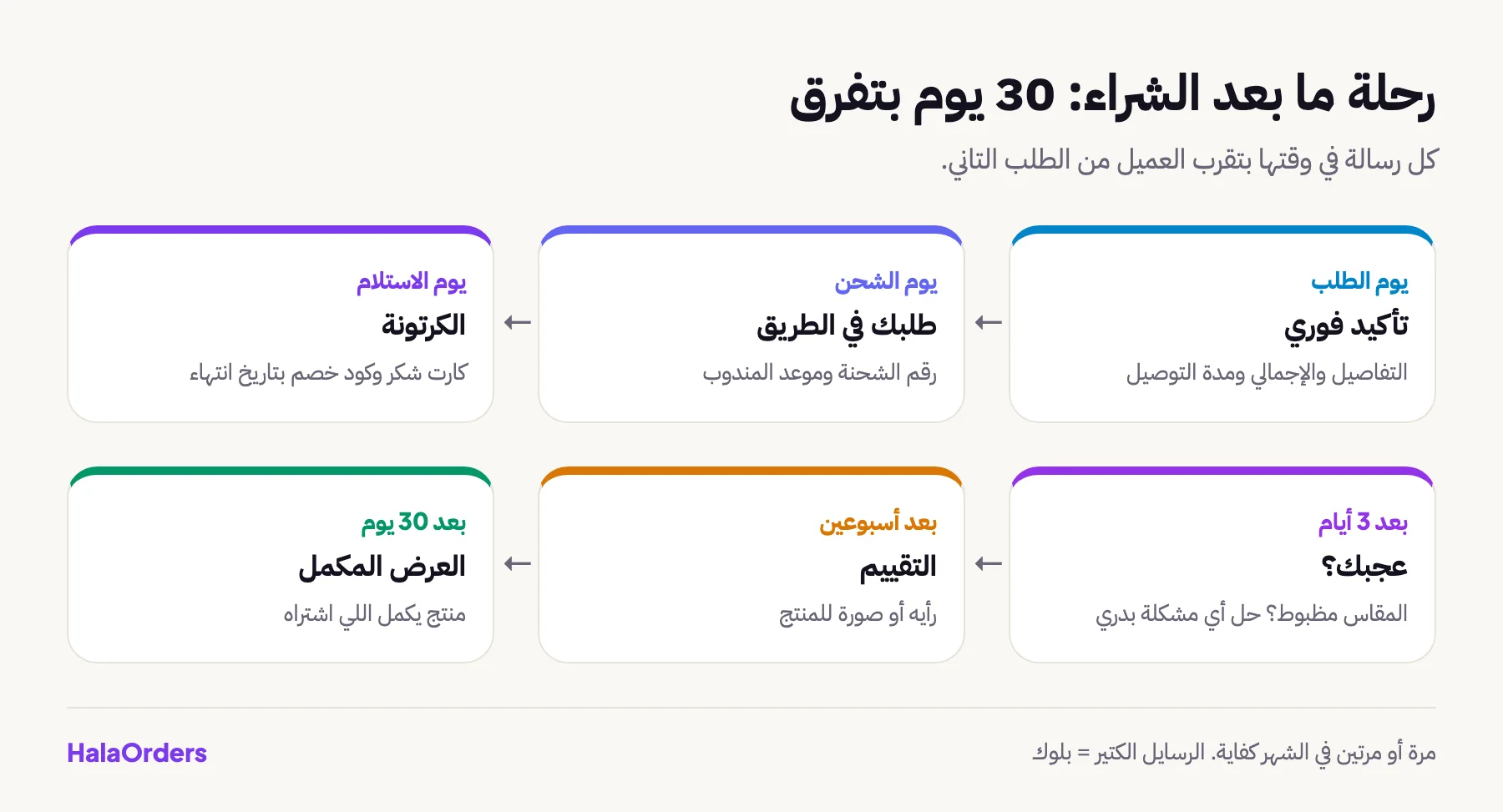
Order day: instant confirmation
An email or message with the order details, the total and the delivery time. A customer who knows where their order is worries less and is less likely to cancel.
Shipping day: "your order is on its way"
A message with the tracking number, the shipping company's name and when to expect the courier. This alone reduces refusals at the door.
Delivery day: the box itself
This is your cheapest marketing channel. Put inside it:
- A thank-you card, handwritten if you can, or printed with a personal touch.
- A promo code for the next order with an expiry date (30 days, for example). The date gets the customer moving.
- How to care for the product (washing, storage, use). This builds trust and reduces returns.
After 3 days: "do you like it?"
A short message asking whether the size fits and the product is what they expected. If there is a problem, find out now and fix it before it turns into a bad review or a customer who never returns.
After two weeks: the review
Ask for a review or a photo of the product in use. Real photos from customers are among the strongest sales tools for new customers too.
After 30 days: the complementary offer
Offer them a product that complements what they bought, not just any product:
- Bought a dress? A scarf or a bag in the same style.
- Bought a bedspread? Pillows in the same color.
- Bought a cream? It runs out in a few days, so remind her to order again.
Ideas that bring customers back (without burning your price)
- A "loyal customer" offer instead of a general discount. A discount for everyone teaches customers to wait for the discount. A private code for your existing customers makes them feel special.
- Bundles: two products that complement each other at a better price. It raises the order value and doesn't look like a discount.
- Reorder reminders for products that run out: perfume, skincare, coffee, baby products. Work out the average time it takes to use one up and message a few days before.
- Early access: your existing customers hear about the new collection or the White Friday offers a day before everyone else.
- Customer service that solves problems: a customer whose problem was solved quickly and politely is often more loyal than one who never had a problem at all.
- Useful content: your store's blog or posts with styling and usage ideas keep you on the customer's mind without selling to them directly.
Things that push customers away
- Too many messages. A message every day = blocked. Once or twice a month is enough for most stores.
- Messages to people who didn't ask. Stick to customers who bought from you or joined your mailing list voluntarily.
- A permanent discount. If there is a discount every week, the original price loses its meaning.
How to start today
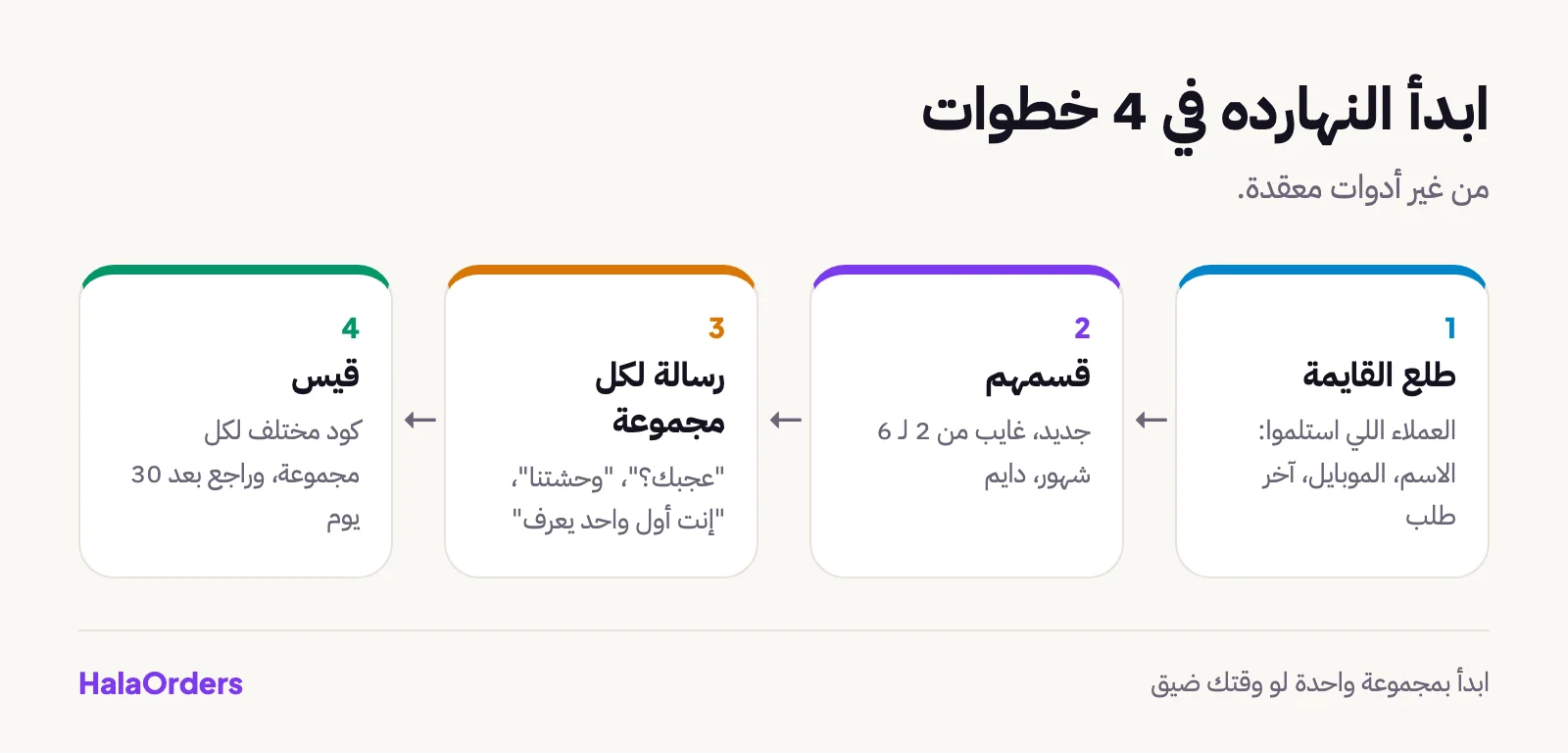
- Pull your customer list from delivered orders: name, phone, product, date of last order.
- Split them into simple groups: bought once less than a month ago, bought 2 to 6 months ago and didn't return, bought more than once.
- A different message for each group: new customers hear "do you like it?", lapsed customers hear "we miss you, here's a code for you", and regulars hear "you're the first to know".
- Measure: use a different promo code for each group, and after 30 days see how many codes were used.
How HalaOrders helps here
- Email notifications: the customer automatically receives an email with their order details and updates, without you sending anything by hand.
- Promo codes: create a dedicated code for each campaign or customer group, as a percentage or an amount, with an expiry date, and measure its use.
- Order history: every order is recorded with the customer's name, phone number, address and products, so you can pull your customer list and group it.
- Mailing list: visitors can subscribe from your store, and subscribers are collected in the dashboard.
- A blog for your store: publish content about your products and how to use them.
- A daily Telegram report: see your numbers for the day as they come in.
If you want to see how improving your order rate affects your profit, try the profit calculator, and read the conversion rate guide to win the first order at a lower cost.
The bottom line
A new customer costs you an ad, and a returning customer costs you a message. If your store relies only on new customers, you start from zero every month. Start with something simple this week: a thank-you card and a promo code in every box, and a "do you like it?" message after 3 days. A month later, see how many came back.
Frequently asked questions
How do I calculate customer lifetime value (CLV)?
Multiply the average order value by the profit margin, by the number of orders per year, by the number of years the customer stays. For example, 500 × 35% × 2.4 × 2 = 840 EGP of profit from the customer.
Why is a returning customer more profitable than a new one?
Because a new customer costs you an ad and a higher refusal rate, while a returning one costs you a message or a promo code. In our example, the same 600 EGP order made 75 EGP of profit from a new customer and 270 from a returning one.
How often should I message my existing customers?
Once or twice a month is enough for most stores, and only to customers who bought from you or joined your list voluntarily.
What is the easiest way to start?
A thank-you card and a promo code with an expiry date in every box, and a "do you like it?" message 3 days after delivery. After a month, see how many codes were used.