Imagine a videographer asks you for 1,500 EGP per video (a hypothetical number for the example), and you need 5 different videos to test which angle works. That adds up to 7,500 EGP before you spend a pound on the ad itself. This is where you start hearing about AI video ads: an avatar talking about your product, and a video made from the product link in minutes.
It is tempting, but there are questions that need honest answers before you try: does it work in Arabic? Do Facebook and TikTok put an "AI" label on the ad? And do people believe a computer-generated face? In this article we go through the best-known tools (Creatify, Arcads and Runway), the rules the platforms have set, and when a real video from a customer wins.
In short: AI video ads save time and money in producing test versions (a video from the product link, or an avatar reading a script), but you must disclose them according to Meta and TikTok policies if they look realistic, and most tools aren't proven to support the Egyptian dialect. Use them for fast testing, and rely on a real video from a customer or from yourself once you find the winning angle.
What is an AI video ad?
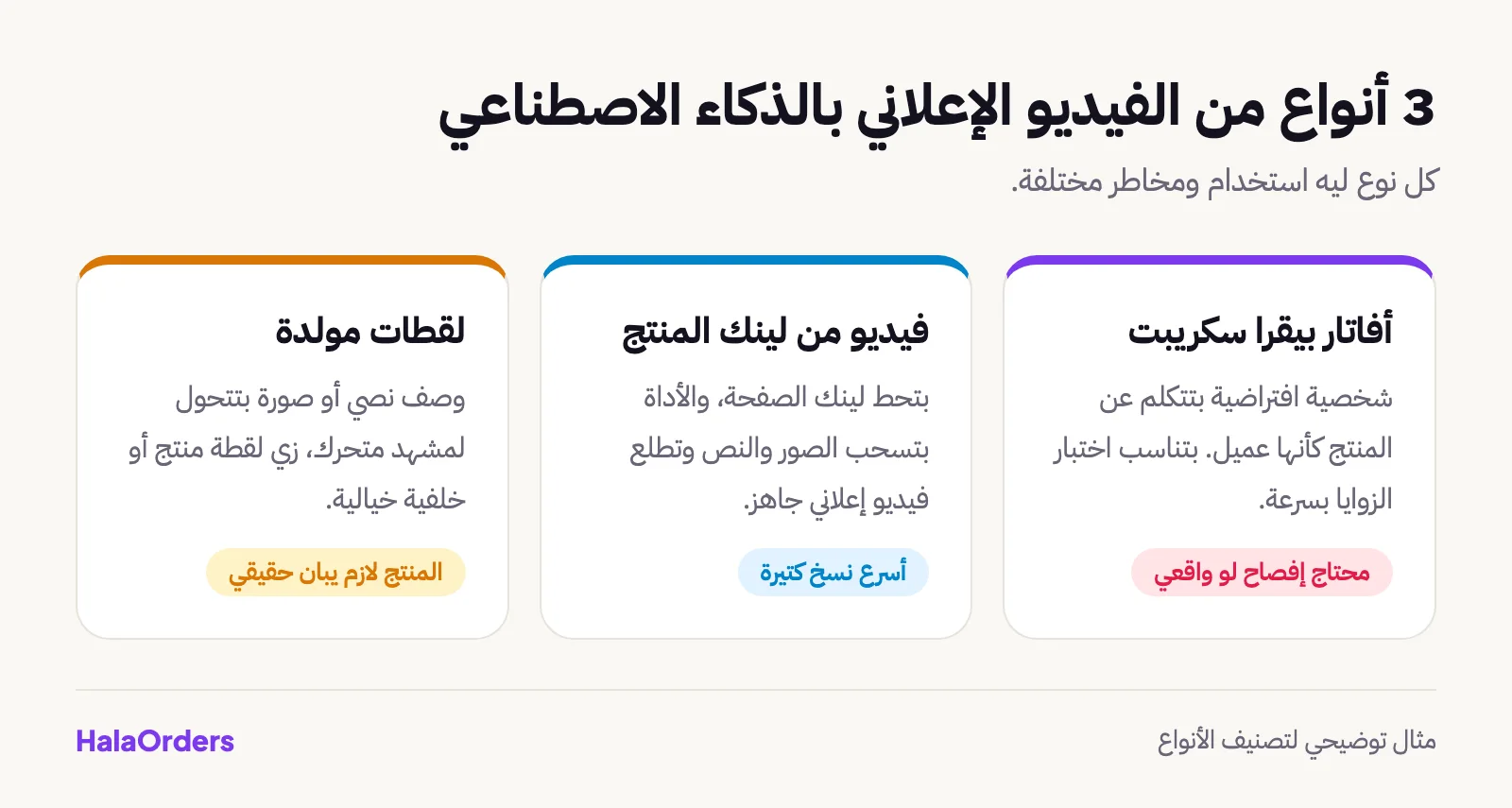
An AI video ad is a short ad video that is generated or edited, in whole or in part, with an AI tool instead of traditional filming. There are 3 very different types:
- An avatar or virtual actor (synthetic UGC): a character reads a script and talks as if they were a customer trying the product.
- A video from the product link: you enter the product page link, and the tool pulls the photos and text and produces a ready ad video.
- Fully generated footage: a text description or an image turned into a moving scene (like a rotating product shot or a fantasy background).
What are the best-known AI video ad tools?
This information comes from the tools' official websites in October 2026, and prices and plans change, so check the website before subscribing.
| Tool | What it does | Who it suits | Arabic | Plan |
|---|---|---|---|---|
| Creatify | Video ads from the product link, avatars and image ads | A store that wants many versions quickly | The website doesn't mention Arabic explicitly | A free start without a card |
| Arcads | Virtual actors (more than 1,000 according to the website) reading a script | Those who want a video that looks like UGC | The website mentions translation into more than 30 languages without naming them | A free trial |
| Runway | Generating and editing video, images and audio | Those who want creative product shots | Not tied to a spoken language | A free trial |
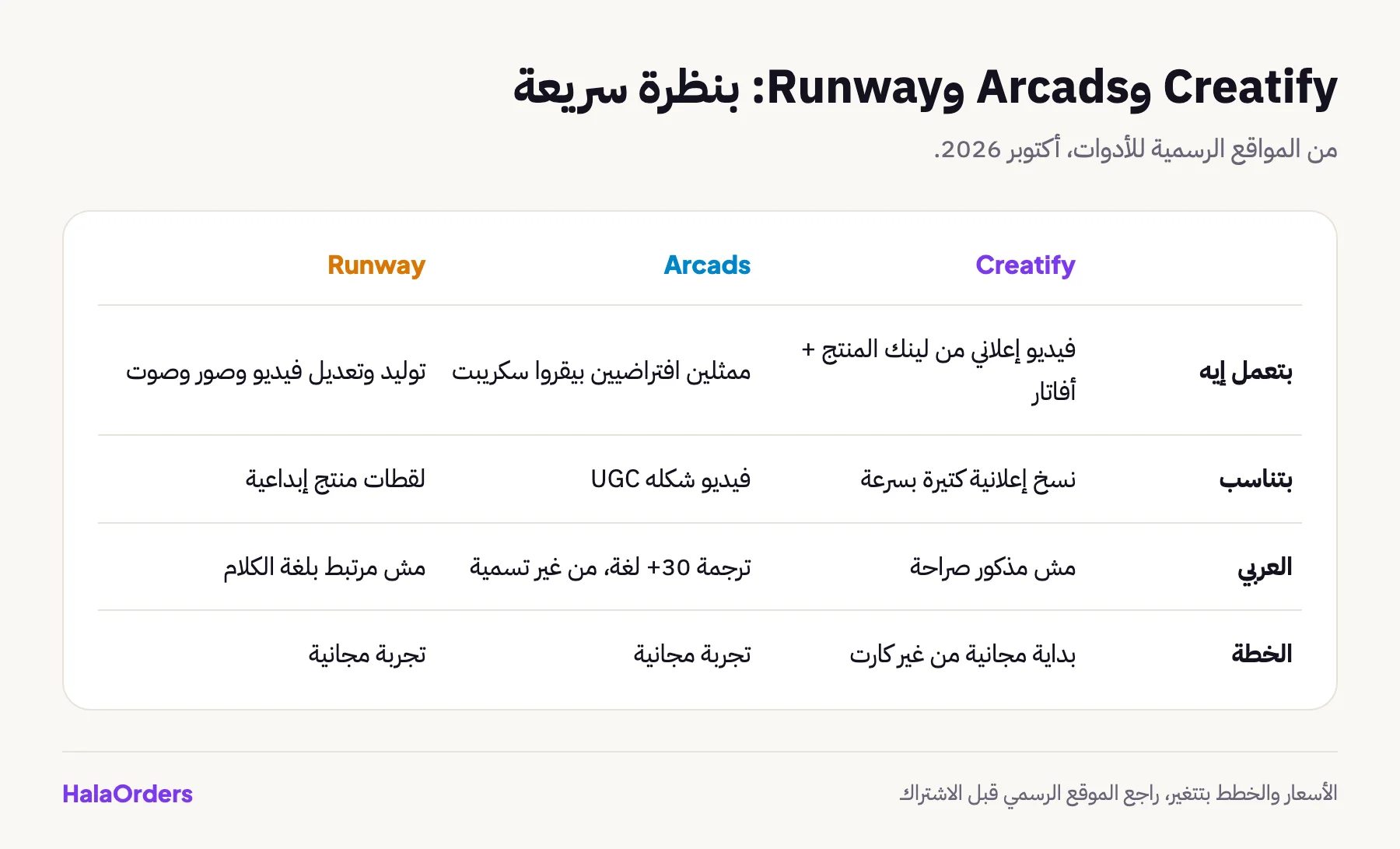
These three tools aren't substitutes for each other. Creatify is closer to a factory for ad versions, Arcads is closer to "a virtual customer talking", and Runway is a general creative tool that needs an idea and a script from you.
Does it work in Arabic and in Egyptian?
That is the most important question for us. None of the three tools says on its official website that it specifically supports Arabic or the Egyptian dialect. So you won't know until you try. Run a small test: a 3-sentence script in Egyptian Arabic, and check the pronunciation, the tone and the lip sync with the voice. If you aren't convinced, the practical fix is to record the voice yourself (even on a phone) and use the tool for the visuals only.
The "AI" label on your ad: what are Meta's and TikTok's rules?
This is the point many people ignore, and it can stop your ad.
Meta (Facebook and Instagram): in February 2025 Meta announced that an "AI info" label would appear in the "About this ad" menu on ads created or significantly edited with its generative AI tools. As for third-party tools, Meta says it will automatically detect ads edited with them using "industry-standard signals" and add the label.
TikTok: according to the TikTok Ads Help Center, an ad containing images, video or audio fully generated by AI, or real footage significantly edited with it, must carry a disclosure. You can use the AI-generated content label in Ads Manager or write a disclosure yourself. It says minor edits (lighting, colors, background removal) don't count. And if TikTok detects undisclosed content, the ad may be rejected or restricted.
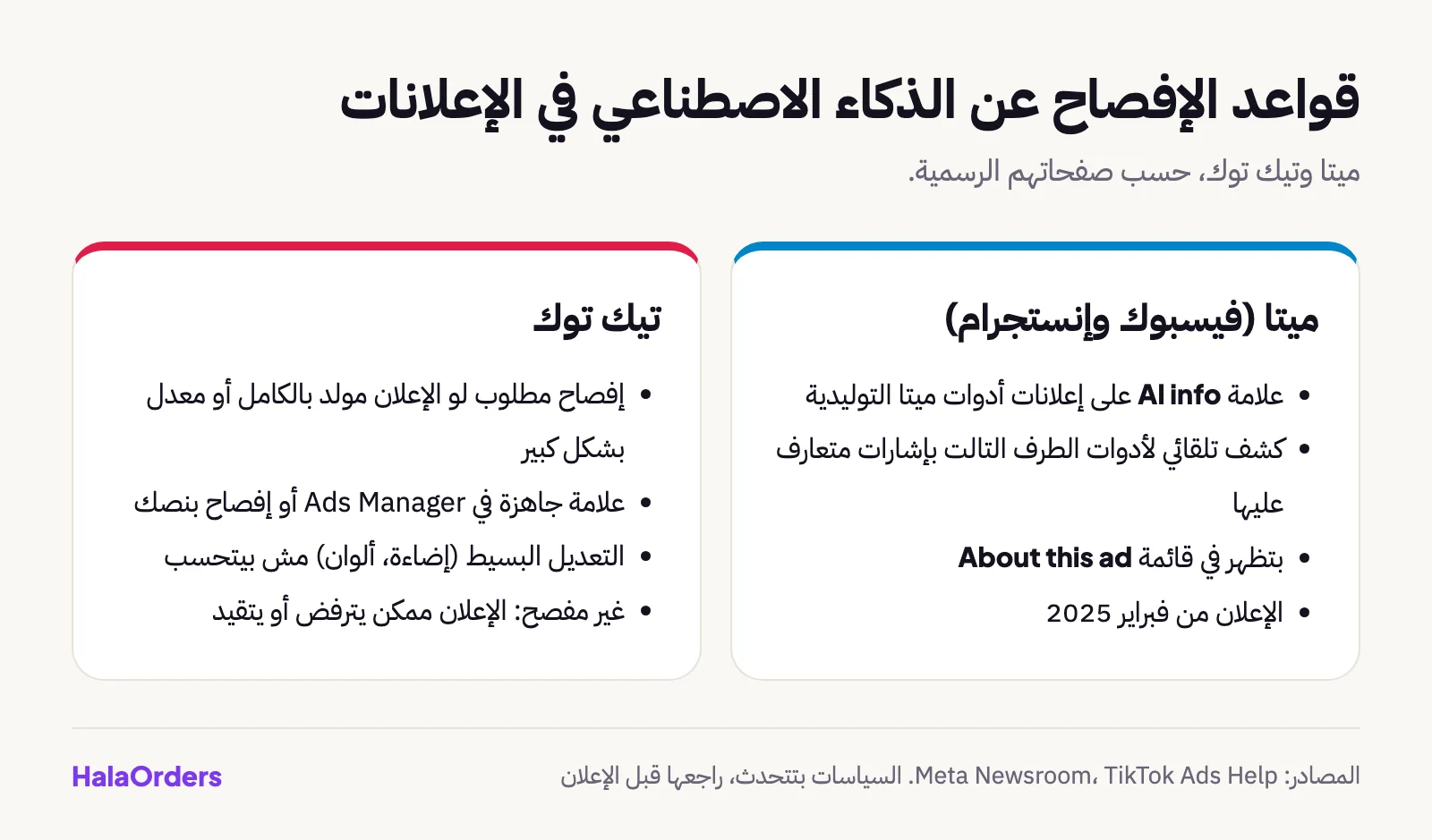
The practical takeaway: if the video includes a generated person speaking as if they were a real customer, disclose it. And don't fake a "customer review" with a virtual character presented as real, because that misleads the buyer and that is what brings you problems and returned orders. Check both platforms' policies yourself before relying on any summary, because they get updated.
When does a real video (UGC) win?
UGC is content made by a customer or an ordinary person showing the product with a phone camera. In marketing, people trust this more than polished ads. According to eMarketer, citing a 2025 PhotoShelter survey, 78% of marketers worldwide said UGC is important to their social strategy, against only 28% who said the same about AI-generated content.
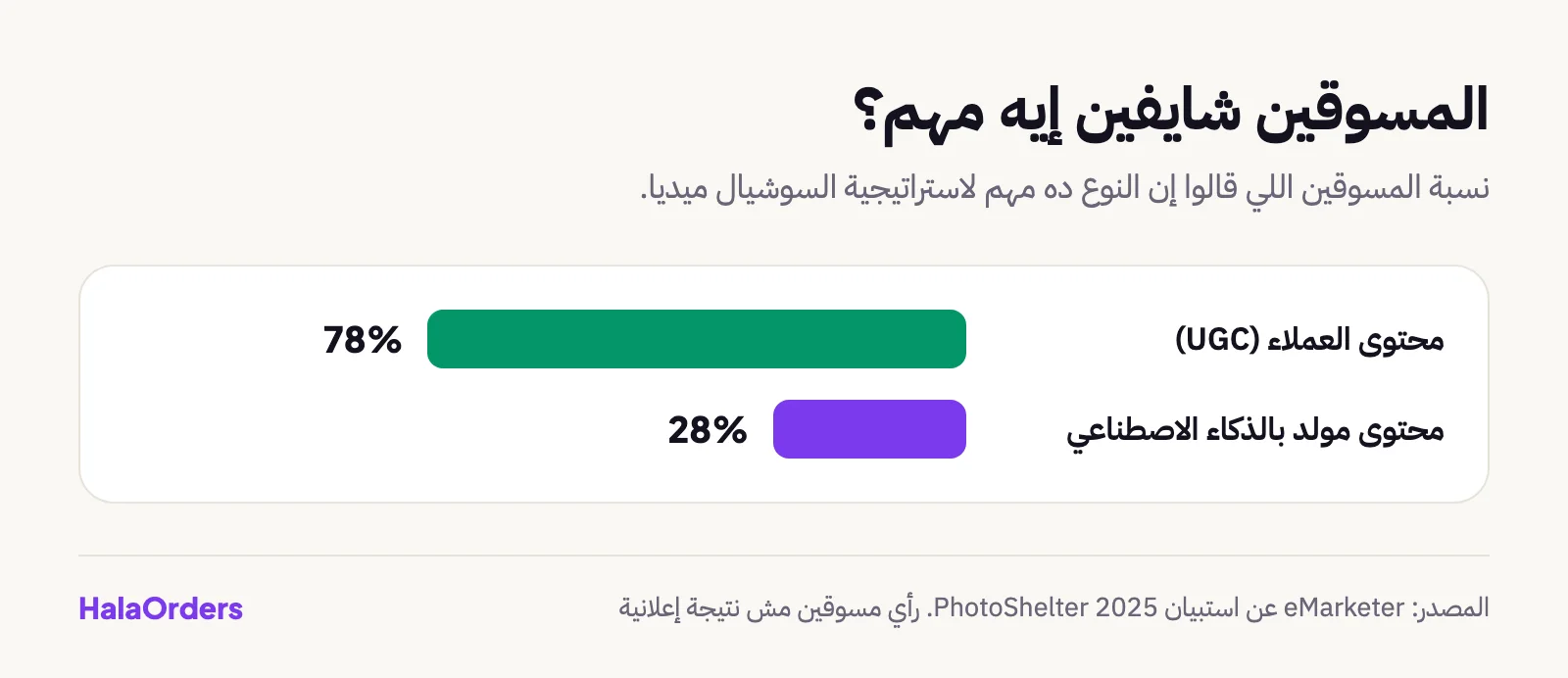
This number is marketers' opinion, not the result of an ad experiment, so don't take it as absolute truth. But its logic makes sense in Egypt in particular:
- Trust in the actual product: if you sell a dress at 650 EGP, the customer wants to see the fabric moving, not an avatar wearing it and saying "excellent".
- Cash on delivery: the more truthful the ad, the fewer refusals at the door, because the customer isn't surprised.
- Products you try with your hands (makeup, food, home tools): a real video explains what an avatar can't.
On the other hand, avatars and videos from the product link help with other things: testing 5 angles quickly, translating a successful video, or making versions in different sizes.
How do you use them together? Practical steps
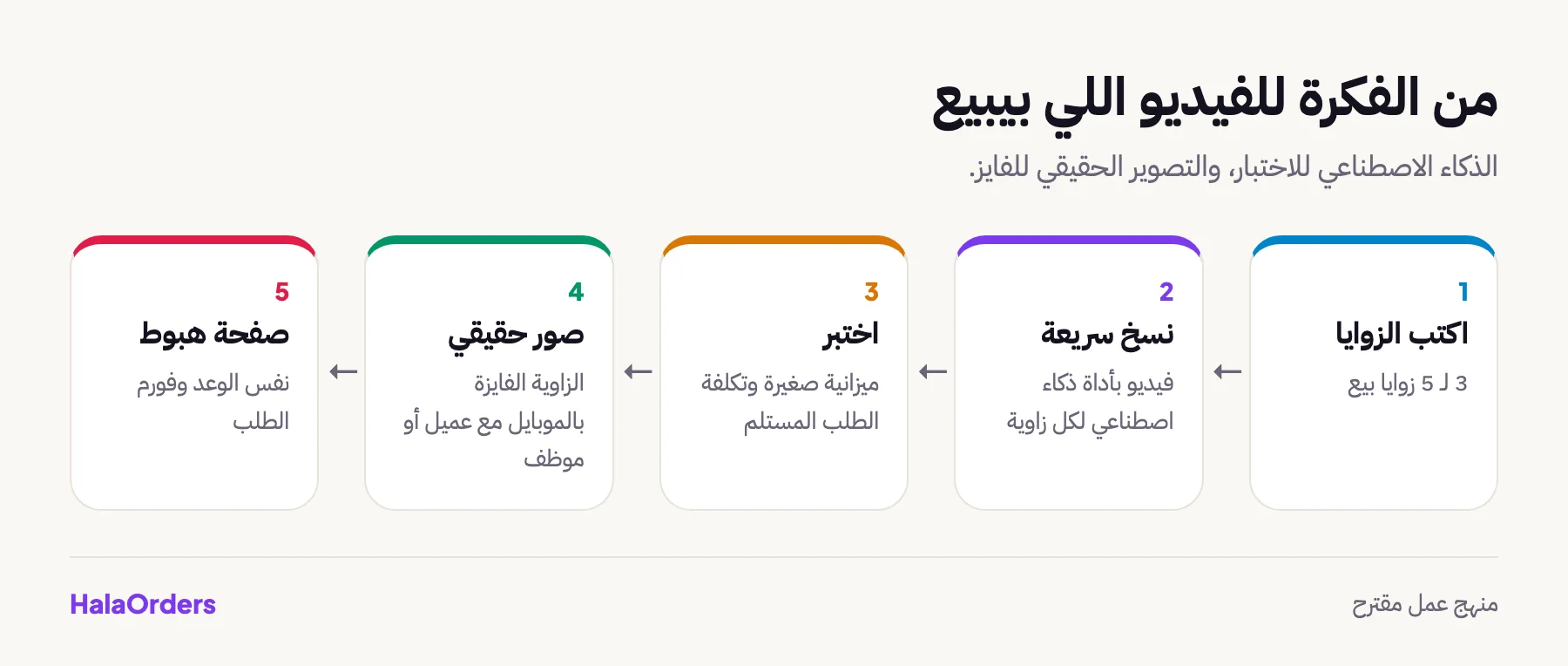
- Write 3 to 5 selling angles (problem and solution, a quantity offer, a comparison, and so on).
- Make a quick AI version for each angle and test it on a small budget.
- Watch which angle wins on the cost per delivered order, not on clicks.
- Shoot the winning version for real: you, a customer or an employee trying the product on a phone.
- Disclose any generated part according to the platform's rules.
- Send the traffic to a clear landing page with the same promise as the video.
Risks you need to know
- The product must look as it really is. If the video makes the product look better than reality, returns will eat your profit. We covered this in AI product photography.
- Image and voice rights. Don't use a real person's face or voice without their permission, and don't imitate a celebrity.
- Customer privacy. Don't put customers' names, numbers or addresses into any AI tool.
- Claims. The tool may write "the best in Egypt" or "guaranteed results". Check every sentence; you are legally responsible for it.
- Quality. Deformed hands, broken Arabic letters inside the video, strange movement. Watch the whole video with sound and picture before uploading it.
If you want to use AI for ad copy and replies, see using ChatGPT in e-commerce and AI tools for e-commerce.
How does HalaOrders help here?
HalaOrders is an Egyptian platform for building online stores and landing pages. It has no AI video or image generation tools, but it covers the part that comes after the video:
- Landing pages with ready templates and a visual editor, the order form on the page, quantity offers and a countdown, suited to an ad that leads to a single product (how to build a landing page for Facebook and TikTok ads).
- A/B testing of up to 4 versions of the page, picking the winner at 95% confidence automatically.
- Connecting the Meta Pixel and TikTok Pixel with the ID from the dashboard, so you know whether the video brings orders or only views.
- Cash on delivery with an optional deposit protects you from refused orders.
- Telegram notifications for every new order and a daily report.
And before the ads themselves, see the Facebook and Instagram ads guide.
The bottom line
AI in video ads is a fast testing tool, not a replacement for honesty. Use it to try angles, disclose what was generated, and when you find the angle that sells, shoot it for real. And keep in mind that Arabic and Egyptian aren't guaranteed in any of the tools, so test them before paying for a subscription.
Frequently asked questions
Do I have to disclose that a video ad was made with AI?
If the video is realistic and fully generated or significantly edited, TikTok requires a disclosure in ads (the AI-generated label or your own text), and Meta adds an AI info label to ads edited with its tools and detects third-party tools automatically. Minor edits such as lighting and colors don't count on TikTok.
Do Creatify and Arcads support Arabic?
Their official websites in October 2026 don't explicitly mention Arabic or the Egyptian dialect. Arcads mentions translation into more than 30 languages without naming them. The fix: try a short script in Egyptian Arabic before subscribing, or record the voice yourself and use the tool for the visuals.
When is it better to use real UGC instead of an avatar?
When the product is tried by hand (makeup, clothing, food) or when trust is the obstacle. According to eMarketer on the 2025 PhotoShelter survey, 78% of marketers see UGC as important versus 28% for AI-generated content. Use avatars for quick testing only.
Is an AI video cheaper than filming?
It usually saves time in producing many test versions, but there is no single cost figure because prices change and plans differ. Calculate the cost of the video you actually accept (after the discarded attempts), not the cost of one attempt.
How do I know a new video worked?
Compare the cost per delivered order for each video, not clicks or views. Send all the videos to the same page with the same offer, so the only difference is the video.